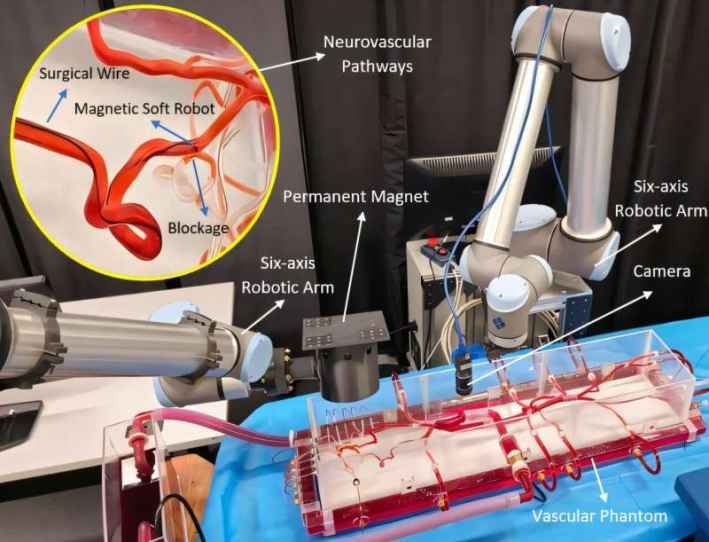
Researchers at Concordia have made a significant breakthrough in the development of a new technique that could revolutionize the treatment of life-threatening blood clots. By combining artificial intelligence with a robotic platform, they aim to enable surgeons to perform safer, faster, and less invasive procedures to address conditions such as blood clots located deep within a patient's neurovascular pathways.
The new technique utilizes magnet-guided soft robots, which have the potential to navigate complex vascular networks with greater precision and accuracy. This could lead to reduced risks of complications and improved patient outcomes. The development of this technology is a crucial step forward in the treatment of blood clots, which can be a major cause of morbidity and mortality if left untreated.
The robotic platform is designed to work in conjunction with the AI-assisted technique, allowing surgeons to precisely guide the soft robots through the patient's vascular system. This enables them to target blood clots with greater accuracy, reducing the risk of damage to surrounding tissue. The use of AI also enhances the surgeon's ability to make informed decisions during the procedure, as it provides real-time feedback and guidance.
The potential benefits of this new technique are numerous, and it could have a significant impact on the treatment of blood clots and other neurovascular conditions. By reducing the risk of complications and improving patient outcomes, this technology could lead to safer and more effective treatments for patients. As researchers continue to develop and refine this technology, it is likely that we will see significant advancements in the field of neurovascular surgery.
The development of this technology is a testament to the power of interdisciplinary collaboration and innovation. By bringing together experts from fields such as robotics, artificial intelligence, and medicine, researchers are able to develop new and innovative solutions to complex medical problems. As this technology continues to evolve, it is likely that we will see new and exciting developments in the treatment of blood clots and other neurovascular conditions.