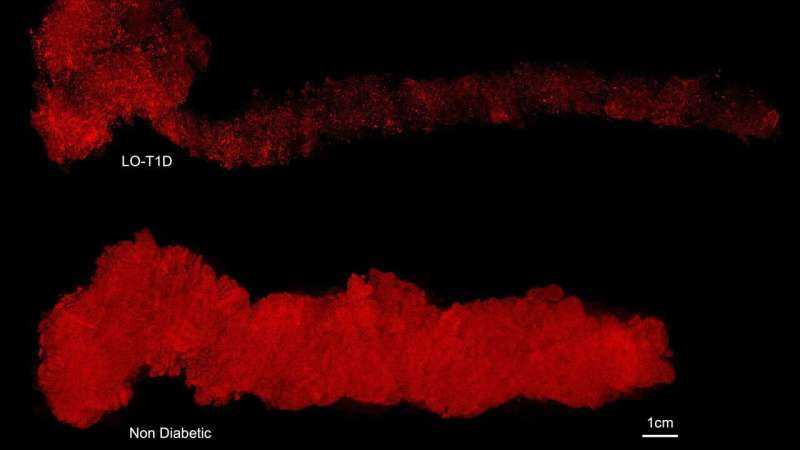
Researchers from Umeå University have mapped an entire human pancreas, revealing insulin-producing cells persist long after type 1 diabetes onset, suggesting a more complex disease progression.
Researchers at Umeå University have made a groundbreaking discovery by conducting a unique three-dimensional mapping of an entire human pancreas. This study has revealed that insulin-producing cells can remain present even after the onset of type 1 diabetes—a finding that challenges previous assumptions about the disease's progression.
The team used advanced imaging techniques to create detailed, whole-organ maps of the pancreas, providing unprecedented insights into its structure and function. By analyzing these images, they discovered that despite the destruction typically associated with type 1 diabetes, some insulin-producing cells persist longer than previously thought.
This discovery is significant because it suggests that the disease's progression may be more complex than initially believed. It could lead to new avenues for understanding the underlying mechanisms of type 1 diabetes and potentially inform future treatments or therapies aimed at preserving these critical cells.
The researchers hope that this novel approach will pave the way for a deeper understanding of how the pancreas functions in both healthy and diseased states, ultimately contributing to improved patient care.