US President Donald Trump arrives in China for talks covering trade truce, Iran war, and arms sales to Taiwan. The two leaders are expected to discuss mutual trade and investment as well as AI issues.
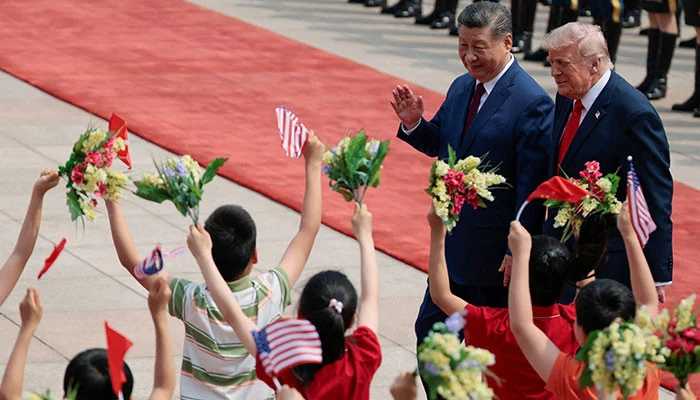
US President Donald Trump arrived at Beijing's Great Hall of the People on Thursday for a high-profile visit that marks his first since 2017. This trip has taken on added significance given Trump's weakened approval ratings due to his involvement in Middle East conflicts. The leaders are scheduled to hold talks, tour historical sites, and attend state banquets over two days.
The power dynamic between the US and China has shifted significantly since Trump's last visit in 2017. Back then, China had been courting the United States by purchasing billions of dollars worth of goods from America. This time around, it is the US that is seeking to acknowledge its growing status. The upcoming meetings are expected to provide ample face-to-face interaction between the leaders.
Despite facing economic and political pressures domestically, Xi Jinping does not appear to be in a position of weakness during these talks. China's economy has faltered somewhat, but it remains resilient compared to the US, which is grappling with tariffs imposed by Chinese authorities and inflation driven by the Iran war.
Both sides are keen to maintain the trade truce that was struck last October, where Trump suspended high tariffs on Chinese goods while Xi backed away from choking global supplies of rare earths. Discussions will likely focus on forums for mutual trade and investment as well as dialogue on AI issues.
Washington is looking to sell Boeing airplanes, farm products, and energy to China in an effort to reduce its trade deficit, which has long irritated Trump. Meanwhile, Beijing wants the US to ease restrictions on exports of chipmaking equipment and advanced semiconductors.
One of the key topics expected during the talks will be Iran. The two leaders are likely to discuss how to resolve the ongoing conflict with Tehran. However, analysts doubt that Xi Jinping will push hard for a resolution or end China's support for Iranian military efforts. Beijing views Iran as a strategic counterweight to US influence in the region.
The visit also includes discussions on arms sales to Taiwan, which has been a contentious issue between the two nations. Despite China’s strong opposition, Trump is expected to press for these sales during his talks with Xi Jinping. The status of a $14-billion package remains unclear as it awaits approval from Trump.
Both leaders are scheduled to visit historical sites and attend state banquets over the course of their meetings. A reciprocal visit by Xi Jinping to the United States later this year is also tentatively planned, marking his first trip since Trump took office in 2025.
In summary, the upcoming talks between Trump and Xi Jinping will cover a range of critical issues including trade relations, Iran's nuclear program, and arms sales to Taiwan. The outcome of these discussions could have significant implications for global politics and economics.