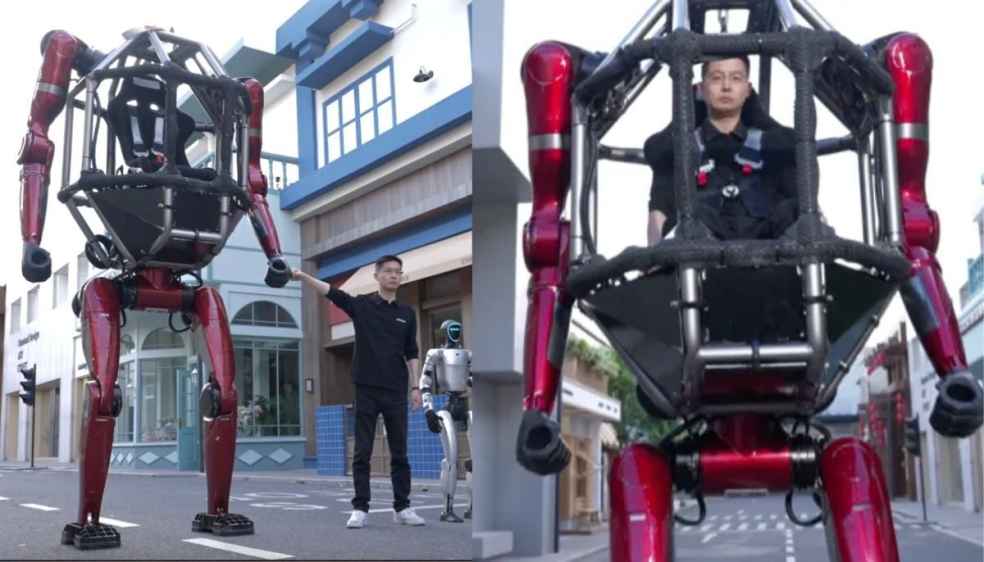
China has unveiled the world's first manned transforming robot capable of bipedal and quadruped locomotion, weighing 500 kg and standing 9 feet tall. The GD01 can break through concrete walls and is set to revolutionize civil industry transport.
Standing at a towering 9 feet and weighing an impressive 500 kilograms, the GD01 has made science fiction feel more like reality with its dual-locomotive capability. Chinese robotics company Unitree Robotics recently announced this pioneering robot, which seamlessly switches between bipedal and four-legged movement. The machine's ability to smash through concrete walls further underscores its remarkable engineering prowess.
The videos accompanying the announcement showcase the GD01's impressive strength and versatility. It demonstrates the power required for each move, highlighting how it can be used in various applications within the civil industry. Unlike stationary industrial robots or humanoid machines with fixed leg positions, the GD01 offers a unique solution that is more akin to a versatile transport vehicle.
According to robotics specialist Lukas Ziegler, while advanced humanoids are being developed by Western countries, China has managed to achieve this feat faster and at a lower cost. Chen Jing, vice president of the Technology and Strategy Research Institute, emphasized that the GD01 is not merely a prototype but a commercial product ready for market release.
Unitree marketing director Huang Jiawei while the initial price tag of $650,000 may vary based on performance optimization and manufacturing costs, the company remains committed to improving the model. The robot's dual locomotion capabilities make it distinct from stationary industrial robots and humanoid machines with static leg positions, offering a new dimension in civil industry transport.
Social media reactions were overwhelmingly positive, with one user describing it as "every boy's dream" while another joked that the world was "ready for a boxing match with aliens." The GD01 represents more than just an engineering marvel; it is poised to transform how we approach transportation and construction within the civil sector.