
Researchers at KAIST discover a neural pathway in mice that enables switching between older and newer memories, enhancing memory updating. Learn more.
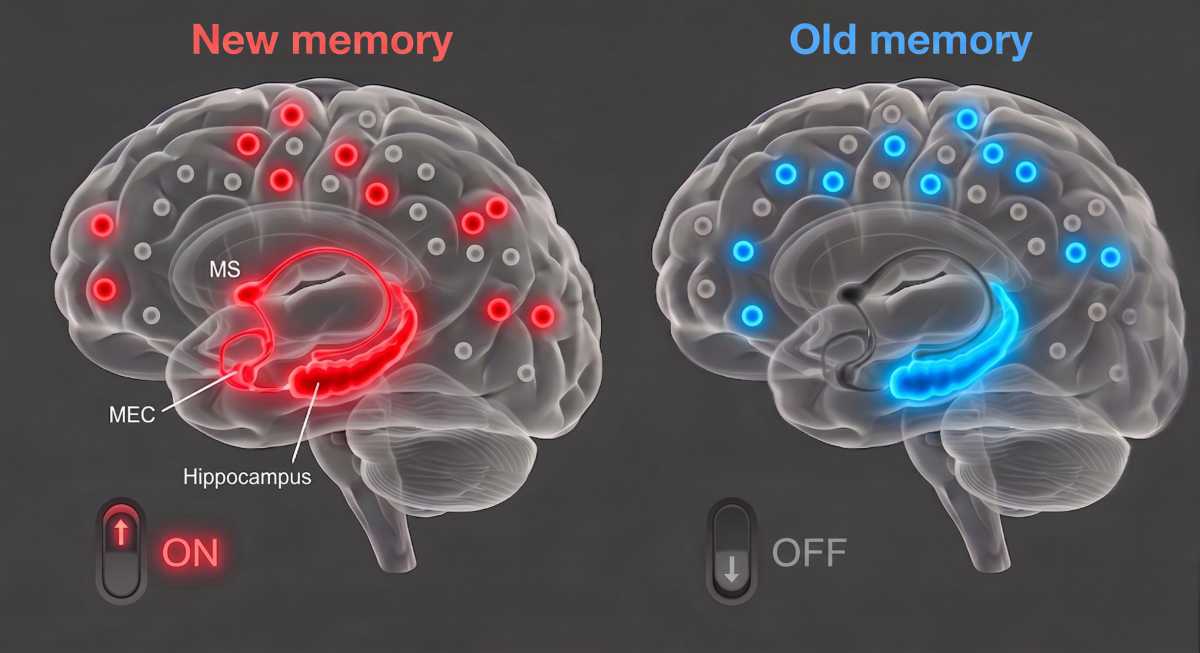
How the brain switches between older and newer memories has long been a subject of interest for neuroscientists. A recent study from KAIST sheds light on this process by identifying a key neural mechanism responsible for organizing retrieval between new and old memories. The research, published in Nature Neuroscience, reveals that GABAergic neurons in the medial septum (MS) project to the medial entorhinal cortex (MEC), forming a pathway crucial for memory updating.
To understand how this works, researchers trained adult male mice to form specific associations between stimuli and rewards, which guided their behavior. They then exposed the mice to new experiences that led them to update these original memory associations. Using neuroimaging techniques, they examined what cells became active during the retrieval of newer, updated memories compared to a single learning episode.
The team found that when MS-MEC GABAergic neurons were inactivated using optogenetic tools, the mice reverted their behaviors back to those performed before their memories were updated. This reversal was not just behavioral; it also affected neuronal activity patterns in the hippocampal CA1 region, indicating that the retrieval process involves an active selection between various available memory traces.
The researchers observed that the duration of the "online" state correlated with memory performance. When this state lasted longer after the animals' memories were updated, mice performed better on memory tasks. This suggests that MS-MEC GABAergic neurons play a crucial role in organizing episodic memories in time within the brain.
"This idea strongly motivated us to search for neural mechanisms that may control shifts and selections between new and old memories during memory retrieval," said lead author Mujun Kim. "Our findings reveal that this GABAergic-dependent selection mechanism contributes to organizing episodic memories in time in the brain."
The study's implications extend beyond basic neuroscience, as disorders such as Alzheimer’s disease (AD), schizophrenia, and autism spectrum disorder (ASD) are characterized by difficulties in updating older memories and forming new ones. Understanding how these mechanisms work could potentially inform treatments for these conditions.
Han emphasizes that further research is needed to explore the detailed circuit mechanisms underlying memory switching control by medial septum GABAergic neurons and identify the cells and connections involved. Additionally, studying this mechanism in disease models like AD, schizophrenia, and autism will be essential for developing effective interventions.
"This finding provides insights into the potential neural basis of these memory disorders," said Han. "It could contribute to the development of interventions that address the underlying mechanisms responsible for memory deficits."
Overall, the study highlights the importance of a flexible switching mechanism in maintaining healthy episodic memory processes and underscores the need for continued research in this area.


