
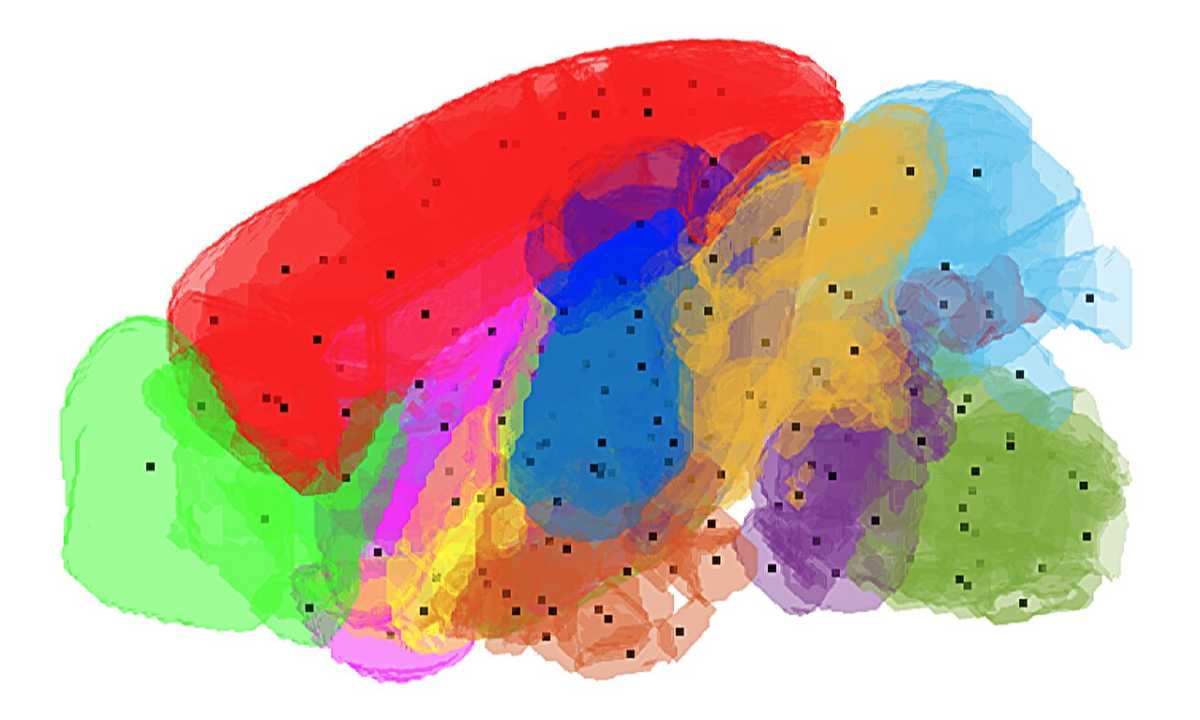
Scientists reveal genes encode a "wiring map" guiding neurons to connect with correct brain regions, offering new insights into brain development.
Scientists have shown for the first time that genes play a crucial role in shaping how neurons form complex neural circuits within the brain. This groundbreaking research published in the Proceedings of the National Academy of Sciences offers new avenues for understanding and potentially treating neurological disorders by revealing how the brain's wiring is genetically designed.
The study, led by researchers from Nagoya University in Japan, aimed to uncover the genetic rules that guide nerve fibers during brain development. These long, thin fibers called axons extend from neurons and transmit signals to other neurons. To understand these connections better, the team developed an analysis method called SPERRFY. This innovative approach combines two datasets: one mapping which brain regions are connected to each other, and another tracking the activity levels of 763 genes across all 213 brain regions in mice.
Naoki Honda, senior author and professor from Nagoya University's Graduate School of Medicine, some genes exhibit distinct patterns of activity throughout the brain. "These differences create unique molecular identities for each brain region," he said. By feeding both datasets into a machine learning algorithm, SPERRFY identified gene expression gradients that predict which brain regions are likely to connect.
The findings were striking: when hundreds of these gene activity profiles overlapped, they provided a precise map of the brain's connections with a prediction-performance score of 0.88 on a scale from 0 to 1. This is significantly higher than predictions based solely on physical distance between brain regions, which scored about 0.70.
Moreover, SPERRFY revealed that the brain's wiring operates at two levels: broad gene activity patterns determine overall organization between brain regions, while more detailed patterns regulate specific connections within them. These molecular gradient maps are created from overlapping activity patterns of many genes across the mouse brain and can be used to reconstruct the brain's connection patterns.
Jigen Koike, first author and former Ph.D. student at Hiroshima University who also conducted research as a special research student at Nagoya University's Graduate School of Medicine, this approach builds on the chemoaffinity theory proposed by Nobel laureate Roger Sperry in 1963. The theory suggests that neurons find their connection partners by following molecular concentration gradients—chemical signals that vary in strength throughout the brain.
Koike explained, "Until now, it was difficult to test whether this principle operates across the entire brain without computational tools. Our findings support the idea that this long-standing principle is not limited to simple sensory circuits but also helps explain how connections are organized across the whole brain."
The researchers identified specific genes with activity patterns that closely matched those of gene expression gradients, supporting the validity of their method and providing a starting point for further research into molecular mechanisms of brain wiring.
"This data-driven framework linking the connectome to spatial gene expression gradients inspired by chemoaffinity theory could be applied to any species for which maps of neural circuits and gene expression data are available," Honda said. As these datasets expand, scientists hope to determine if similar molecular wiring principles exist across different species and how they have evolved.
The implications of this research extend beyond basic neuroscience; it may help in understanding disruptions in brain wiring that contribute to neurodevelopmental disorders. By providing a detailed map of the brain's neural circuits, SPERRFY could also assist in developing new treatments for conditions such as autism spectrum disorder (ASD) and attention deficit hyperactivity disorder (ADHD).
As researchers continue to refine this method, it is hoped that it will lead to more personalized therapies tailored to individual genetic profiles. This study marks a significant step forward in our understanding of how the brain's complex wiring system develops and functions.


