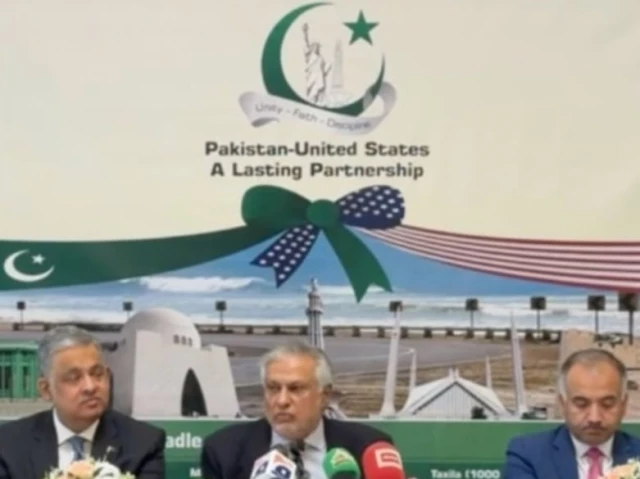
Deputy Prime Minister and Foreign Minister Ishaq Dar reiterates Pakistan’s stance against joining the Abraham Accords until an independent Palestinian state is recognized.
Deputy Prime Minister and Foreign Minister Ishaq Dar firmly rejected any notion of Pakistan joining the Abraham Accords on Friday. He emphasized that there would be no flexibility in Islamabad's position until Palestine is recognized with pre-1967 borders, including Al-Quds Al-Sharif as its capital. Addressing the media at the Pakistan Embassy in Washington, DC, Dar clarified, "There are a lot of rumors going on related to the Abraham Accord, let me clear that Pakistan’s stance is very clear and consistent on that. Until Palestine is recognized with the pre-1967 model with Quds Al Sharif as its capital, there will be no flexibility."
The foreign minister's statement came after US Secretary of State Marco Rubio acknowledged Pakistan's "sincere diplomatic and mediatory efforts" for peace in the region during a meeting. Rubio highlighted Pakistan's role in supporting stability and emphasized the importance of simultaneous signings of the Abraham Accords.
In his social media post, President Donald Trump had previously expressed his desire to expand the accords, listing several countries including Pakistan as potential signatories. However, Dar’s statement reaffirms Pakistan's long-standing commitment to an independent Palestinian state based on pre-1967 borders and Al-Quds Al-Sharif as its capital.
Last year, after US Special Envoy for the Middle East Steve Witkoff suggested additional countries were preparing to join the accords, Foreign Minister Dar had similarly ruled out recognition of Israel. He stated, "We are not ready to recognize Israel until the two-state solution to the Palestine conflict is accepted." Dar further emphasized that signing the Abraham Accords would amount to abandoning Pakistan's longstanding demand for a Palestinian state with Al-Quds Al-Sharif as its capital.
The minister’s stance underscores Pakistan's unwavering commitment to the principles of the two-state solution and highlights the country's consistent position on the Palestine issue.