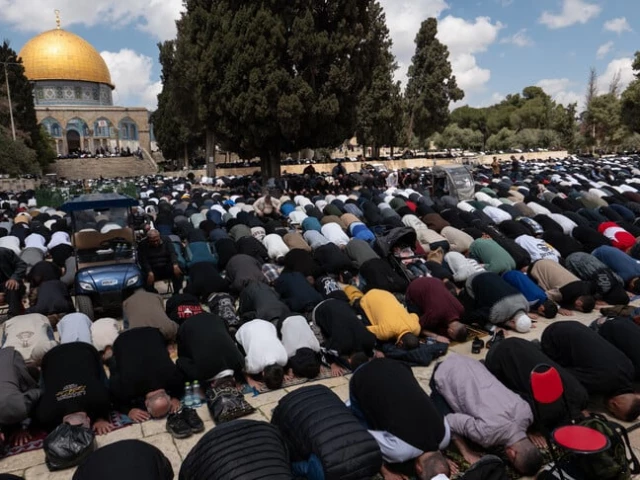
Muslims gather at Al-Aqsa Mosque to celebrate Eidul Azha, while others in southern Lebanon face displacement and uncertainty due to ongoing Israeli attacks and security fears, affecting traditional holiday celebrations.
The Al-Aqsa Mosque in occupied Jerusalem was filled with Muslim worshipers performing Eid prayers on the first day of the four-day Eidul Azha holiday. This significant occasion commemorates the readiness of Prophet Ibrahim to sacrifice his son on God's command, and Muslims traditionally mark it by sacrificing animals and distributing the meat to the poor. However, this year's celebrations are overshadowed by continued Israeli violations of a ceasefire agreement in force since October 2025, resulting in the deaths of over 880 people and injuries to more than 2,645 in Israeli attacks since October 10.
The Eidul Azha holiday is one of the most important in the Muslim calendar, but for many residents in southern Lebanon, it has been marred by displacement, uncertainty, and the lingering impact of war. In the Arqoub region, Israeli attacks and security fears have altered daily life, stripping the holiday of many of its familiar traditions. Schools have become shelters for displaced families, and many residents are reluctant to return home despite the holiday season. Those who have stayed behind are trying to preserve fragments of tradition, from preparing Eid sweets to gathering with the few family members who remain nearby.
In towns such as Shebaa, Kfarhamam, and Marj al-Zouhour, the effects of displacement and war are evident. Nasreen Abdul Aal, a 34-year-old woman who has been displaced three times from Ain Arab village, lives with her family in a school that has been turned into a shelter. She expressed the deep psychological scars that repeated displacement has left on families and children, saying that families no longer gather, and children can no longer recognize the atmosphere of Eid. Farmers have lost harvest seasons and livelihoods, and many families fear losing their homes entirely amid continued attacks.
The situation in Kfarhamam is similar, where Um Najib Fares, a 60-year-old woman, has refused to leave her home despite intensified nighttime airstrikes and shelling. She explosions have become part of daily life, and holidays that once brought together children and grandchildren have become occasions marked by absence. Kfarhamam Mayor Mouad Rahhal described the unprecedented social emptiness across border villages, where many displaced families hesitate to return even during religious holidays for fear of worsening security conditions. Despite the difficult conditions, around 110 families remain in the town, and some residents, like 83-year-old Rasmiya Zoghbi, still insist on preparing traditional Eid cookies, hoping that holidays will one day return to being a time for goodness and prayers that families may one day return home.
The Israeli army's expanded offensive on Lebanon, which began on March 2, has killed nearly 3,200 people, injured over 9,600, and displaced over 1.6 million people, according to official figures. The US-mediated ceasefire that took effect on April 17 and was later extended to early July has not stopped the daily attacks, leaving many to wonder when the violence will end and the region can return to a sense of normalcy. As Muslims around the world celebrate Eidul Azha, the situation in southern Lebanon serves as a reminder of the human cost of conflict and the importance of finding a lasting solution to the region's problems.