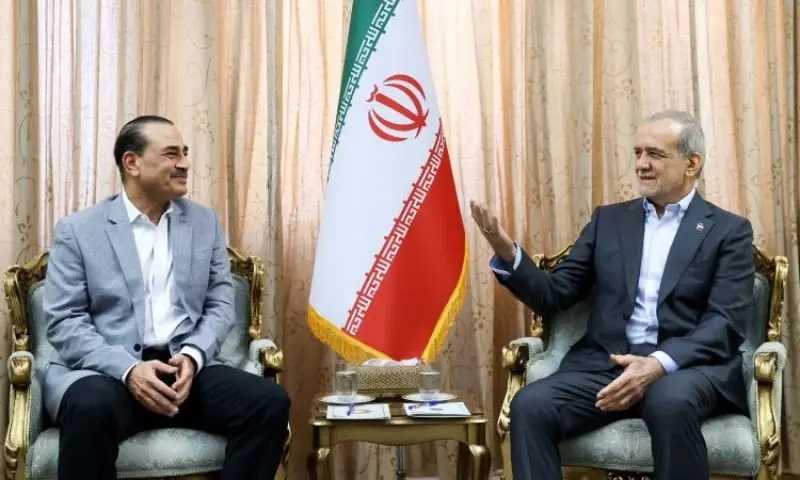
Chief of Defence Forces and Army Chief Field Marshal Asim Munir made encouraging progress in talks with Iranian leadership, according to ISPR.
Chief of Defence Forces (CDF) Field Marshal Asim Munir conducted intensive negotiations with the Iranian leadership over the past 24 hours that have resulted in "encouraging progress towards a final understanding," as stated by the Inter-Services Public Relations (ISPR) on Saturday. The engagements were held in a "positive and constructive environment" and contributed meaningfully to ongoing mediation efforts aimed at promoting de-escalation and constructive engagement, ISPR reported.
The visit came amid negotiations that had moved beyond political signalling into detailed bargaining over a narrow interim framework concerning the Strait of Hormuz, Iran's nuclear programme, sanctions relief, and guarantees against renewed military action. During his visit, Field Marshal Munir held high-level engagements with Iranian leadership as part of these mediation efforts. The discussions focused on expediting the ongoing consultative process to "support peace and stability in the region and reach a conclusive agreement."
ISPR further the Iranian leadership appreciated Pakistan's sincere and constructive role in facilitating dialogue and promoting "peaceful settlement of regional issues." During his visit, Field Marshal Munir met President Masoud Pezeshkian, Speaker Mohammad Bagher Ghalibaf, Foreign Minister Abbas Araghchi, and Interior Minister Eskandar Momeni.
Pakistan has stepped up its diplomatic efforts to break the deadlock by sending the interior minister to Tehran on Wednesday for a second time in less than a week. He had previously met Iran's president, parliament speaker, and foreign minister over the weekend. The CDF previously visited Iran for three days last month alongside Interior Minister Mohsin Naqvi, where he held meetings with Iranian Foreign Minister Abbas Araghchi and other officials.
The military's media wing described the visit as part of "ongoing mediation efforts" to de-escalate tensions between Iran and the US. The mediation process around Tehran has widened over the past 48 hours. Qatar also dispatched a negotiating team to the Iranian capital in coordination with the United States, while Saudi Interior Minister Abdulaziz bin Saud Al Saud spoke to Naqvi in Tehran.
An Iranian diplomat in China praised Beijing for presenting a peace initiative during the war "with the support of Pakistan." Regional diplomats pointed to signs of softer Emirati messaging in favor of de-escalation and uninterrupted maritime trade. The latest round of contacts is taking place under heightened pressure from the US and its Middle East allies.
US President Donald Trump on Wednesday said talks in Iran were nearing their final stages, threatening to resume strikes if a deal is not reached within a "limited timeframe." Meanwhile, Iran warned of confrontation beyond the Middle East in case of a US attack but also insisted that all paths remained open to avoid hostilities. A day earlier, US Secretary of State Marco Rubio praised Pakistan's mediation role, describing it as Washington's "primary interlocutor" in the talks.
Diplomats the evolving process increasingly resembled a phased stabilisation effort rather than negotiations on a comprehensive settlement.