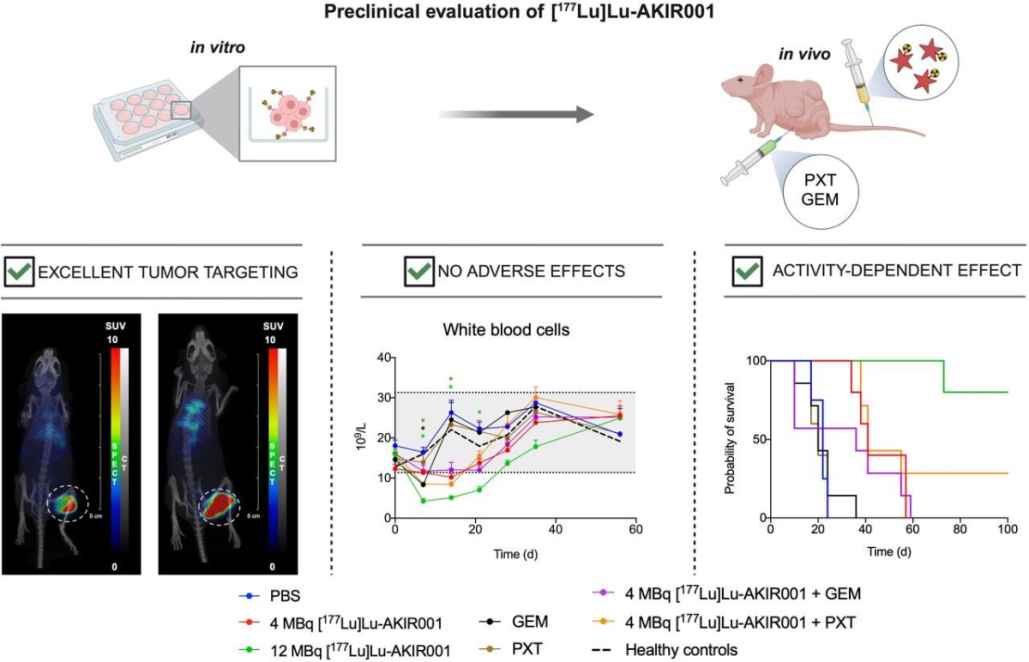
A newly developed targeted radiopharmaceutical treatment has demonstrated significant efficacy against pancreatic ductal adenocarcinoma (PDAC), a highly aggressive form of cancer. According to research published in The Journal of Nuclear Medicine, the therapy achieved complete remission in preclinical models and showed activity-dependent tumor growth inhibition.
Pancreatic Ductal Adenocarcinoma (PDAC) accounts for more than 90% of all pancreatic cancer cases and has a five-year survival rate below 5% among patients with metastatic disease. Despite the availability of surgery as the only curative option, it is feasible in only 10-20% of localized PDAC cases.
In a study conducted by researchers at Uppsala University in Sweden, the CD44v6-targeted radiopharmaceutical 177Lu-AKIR001 was evaluated both as a standalone treatment and when combined with standard chemotherapy. The research team assessed CD44v6 expression, radioligand binding, and chemotherapy sensitivity across four PDAC cell lines.
Mice bearing PDAC xenografts were then administered either 177Lu-AKIR001 alone, chemotherapy alone, or a combination of both treatments. Therapeutic efficacy and toxicity for each treatment approach were meticulously determined through tumor uptake analysis and clinical outcomes evaluation.
The study revealed that three out of the four PDAC cell lines expressed CD44v6, indicating its potential as a targetable biomarker. In vivo studies demonstrated strong and selective tumor uptake of 177Lu-AKIR001, with notable tumor growth inhibition observed in mice treated with either 12 MBq or 4 MBq of the radiopharmaceutical combined with paclitaxel chemotherapy.
Notably, no significant toxicity was observed across all treatment groups. Professor Marika Nestor from Uppsala University highlighted that targeted radiotherapies have already transformed outcomes for prostate and neuroendocrine tumors, suggesting that CD44v6 could be another viable target in this therapeutic approach.
The clinical program evaluating 177Lu-AKIR001 is currently expanding to include broader patient populations. This research can guide future applications of the treatment, particularly in patients with other malignancies where CD44v6 expression may also be relevant.
As PDAC remains one of the most lethal cancers globally, this targeted radiopharmaceutical therapy offers hope for improved outcomes and more precise cancer management strategies. Further clinical trials will be necessary to validate these promising preclinical results and explore its potential as a standard treatment option.