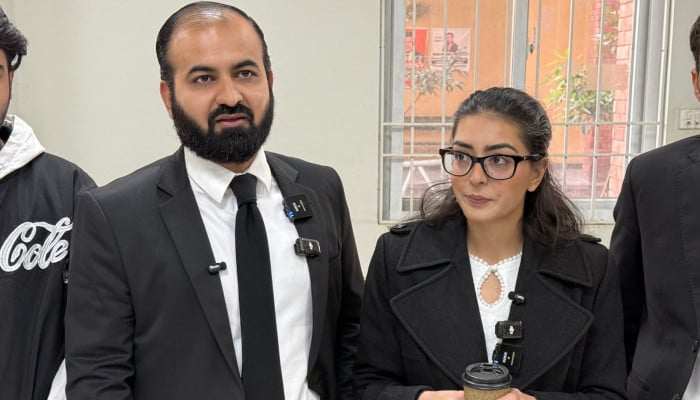
Supreme Court directs Islamabad High Court to rule on sentence suspension requests by human rights lawyer Iman Mazari and her husband Hadi Ali Chattha, following their arrest and conviction.
The Supreme Court has directed the Islamabad High Court (IHC) to decide the sentence suspension pleas filed by human rights lawyer Iman Mazari and her husband, fellow activist Hadi Ali Chattha. The three-member bench, headed by Justice Shahid Waheed with Justices Naeem Akhtar Afghan and Shafi Siddiqui, heard the case related to the suspension of their sentences.
In January, a district and sessions court in Islamabad sentenced the couple to 17 years each under different sections of the Prevention of Electronic Crimes Act (Peca), just one day after their arrest. The couple then moved the IHC against their sentence in early February. At today's hearing, counsel Faisal Siddiqi informed the court that the high court had only issued notices on the appeals against conviction and had not resumed hearings for more than two months.
Siddiqi argued: "Our clients have received no relief from the Islamabad High Court." He added that the court should order a decision on the sentence suspension pleas. Justice Afghan observed that the high court had neither passed any adverse orders against the petitioners nor rejected their applications for suspension of sentence. He questioned under what parameters a sentence could be suspended, suggesting it would depend on whose door the lawyer would knock if the IHC does not provide relief.
Justice Shahid Waheed proposed directing the high court to decide the appeals within two weeks, while counsel insisted that the IHC should specifically be ordered to decide the suspension applications. The Supreme Court's directive leaves the matter pending before the apex court until the high court's ruling is made.
The couple has been facing legal challenges since their arrest in January, with their case drawing attention for its implications on human rights and electronic crime laws in Pakistan. Their case highlights ongoing concerns about judicial delays and the impact of arrests on individuals' ability to challenge convictions through higher courts.