Pakistani and Chinese companies signed agreements worth over $7 billion during high-level business engagements in Hangzhou, focusing on technology, energy, and agriculture.
Pakistani and Chinese firms inked significant deals totaling more than $7 billion during a series of business conferences led by Prime Minister Shehbaz Sharif in Hangzhou. The agreements covered sectors such as information technology, telecommunications, renewable energy, battery storage systems, and agriculture. During the Pakistan-China Business-to-Business Investment Conference, Shehbaz invited Chinese companies to relocate industries to Pakistan or form joint ventures under a "win-win" model.
The prime minister highlighted opportunities for Chinese firms to establish manufacturing plants in Pakistan, particularly in sectors like textiles, leather, and industrial production. He also encouraged investments in export zones, such as the planned special economic zone in Karachi, which would offer modern infrastructure and lease facilities. Shehbaz assured Chinese companies of "red-carpet treatment" and similar world-class economic zones elsewhere in Pakistan.
A major deal included a $1.12 billion agreement between Haolu Engineering and Technology Company and Fauji Fertilizer for fertiliser production. Another MoU worth $100 million was signed between IBI Beijing United Information Technology and the RIC for agrochemicals, agricultural machinery, and establishing a regional office in Multan.
The conference saw more than 200 MoUs with over $20 billion in value, of which nearly 30% had already been converted into formal agreements. Prime Minister Shehbaz implementation would remain the government's priority.
During his visit to Alibaba Group headquarters, Shehbaz discussed strategic cooperation plans and signed a long-term framework agreement aimed at accelerating Pakistan’s digital transformation. Alibaba Chairman Joe Tsai outlined expansion in cloud infrastructure, data centers, trade facilitation, telemedicine, smart hospitals, pharmaceuticals, financial literacy, and agriculture under the Belt and Road Initiative.
Several additional agreements were signed, including collaboration on developing localised AI models for Urdu and regional languages, joint training programs, healthcare initiatives, and support for Pakistani SMEs through e-commerce platforms. In finance, Koko Tech agreed to introduce a "Buy Now, Pay Later" solution in Pakistan with an initial investment of $3 million.
The prime minister also met with executives from major Chinese companies like Sheng Huo Neng Yuan Ke Ji Company, CATL, StarCharge, and Xiuzheng Pharmaceutical Group. Discussions focused on renewable energy, electric vehicle charging infrastructure, pharmaceutical manufacturing, and healthcare cooperation.
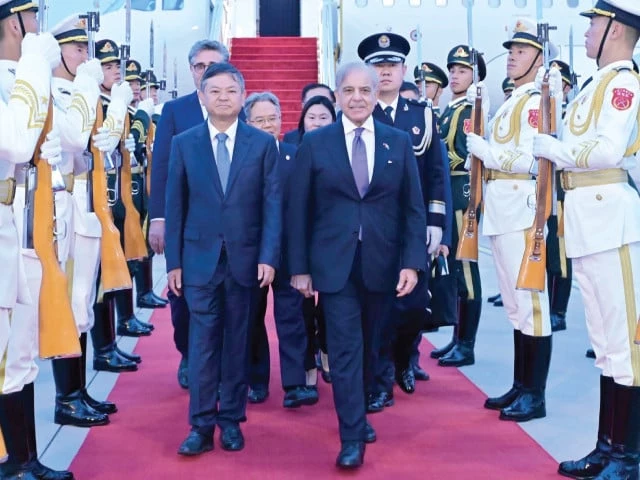
Following his Hangzhou engagements, Prime Minister Shehbaz Sharif arrived in Beijing for high-level meetings with Chinese President Xi Jinping and Premier Li Qiang to discuss trade, investment, agriculture, science and technology, industrial cooperation, and the second phase of the China-Pakistan Economic Corridor. The visit coincided with the 75th anniversary of diplomatic relations between Pakistan and China, a milestone repeatedly emphasized by Shehbaz during his speeches in Hangzhou.