National Institute of Population Studies, Training and Research leads population projections exercise with UNFPA support in Pakistan.
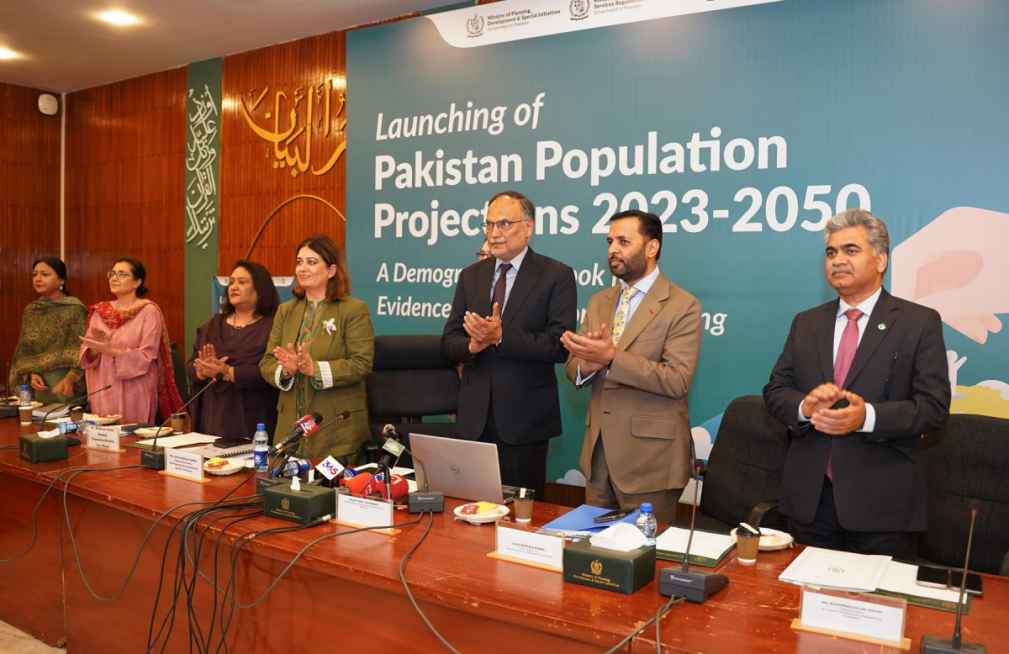
The National Institute of Population Studies, Training and Research (NIPST&R) has led the Population Projections Exercise (2023–2050), a significant initiative supported by the United Nations Population Fund (UNFPA). This effort aims to provide updated and evidence-based population estimates at both national and provincial levels. The exercise was appreciated by Federal Ministers for Health, Syed Mustafa Kamal, and Planning, Dr. Ahsan Iqbal.
In a press release on Tuesday, these officials highlighted NIPST&R's professionalism, technical rigor, and strong sense of national responsibility. They commended the Executive Director, Mrs. Samina A. Hasan, and Ms. Rabia Zafar, Director and Technical Working Group (TWG), for their valuable oversight and expert input.
Dr. Ahsan Iqbal particularly acknowledged the contributions of Dr. Ghulam Muhammad Arif, who led the Sub-Committee of the TWG, along with esteemed members such as Drs. Mehtab Karim, Tauseef Ahmed, Durre Nayab, Saima Bashir, Hussain Ahmed, Muqaddar Shah, and Farah Ashraf. Their expert review and guidance ensured the technical soundness and credibility of the projections.
The exercise also recognized the support from the United Nations Population Fund (UNFPA), particularly Dr. Luay Shabaney, Country Representative. Without this support, the national exercise would not have been possible.
Building on this evidence-based foundation, the latest population projections present two potential futures for Pakistan based on different fertility trends: a Slow Decline Scenario and a Rapid Decline Scenario. The Slow Decline Scenario reflects current fertility trends, while the Rapid Decline Scenario illustrates what could happen if effective policies and interventions accelerate fertility reduction by 0.5.
These scenarios are not just numbers; they represent the people we serve, families who depend on our health system, and the challenges and opportunities that lie ahead for our nation's wellbeing. With Pakistan’s total population estimated at 241.86 million according to the 2023 Population and Housing Census, these projections offer valuable insights into future demographic trends.
The National Institute of Population Studies, Training and Research (NIPST&R) continues its vital role in providing robust data for policymakers and stakeholders to make informed decisions that will shape Pakistan's development trajectory.