The Institute of Strategic Studies Islamabad hosted the launch of Marc Saxer's book, exploring the emerging multi-polar world order and its implications for global governance and international relations.
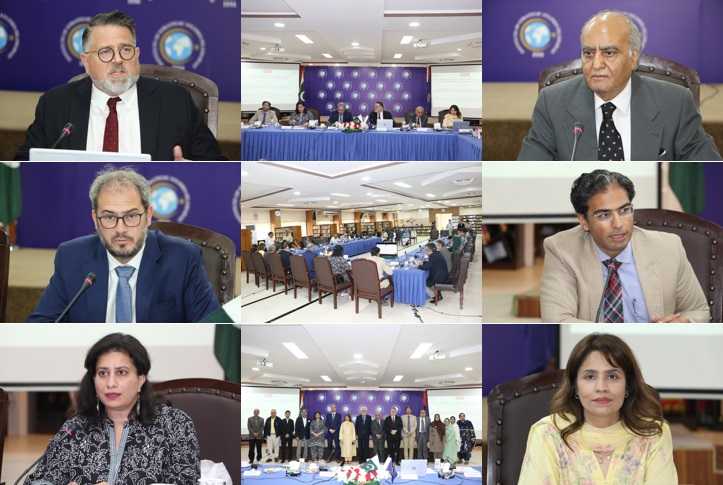
The Institute of Strategic Studies Islamabad recently hosted the launch of a book titled "Geopolitical Conflict in the Wolf World, Great Power Competition and the Illiberal Revolt against the Liberal Order," authored by Marc Saxer, Regional Director of the Office of Regional Cooperation in Asia Pacific at Friedrich Ebert Stiftung. The event was organized by the Centre for Afghanistan, Middle East and Africa and attended by diplomats, academics, students, practitioners, and members of civil society.
Ambassador Khalid Mahmood, Chairman of the Board of Governors at the Institute of Strategic Studies Islamabad, expressed his views on the book, stating that it offers an insightful analysis of the evolving global order characterized by intensifying great power competition, geo-economic rivalry, and the gradual erosion of the liberal international order. He the book's discussion on the emergence of an increasingly multipolar world and the importance of strategic and pragmatic engagement and diversified partnerships carries particular relevance for countries like Pakistan.
Dr. Amina Khan, Director of the Centre for Afghanistan, Middle East and Africa, observed that Marc Saxer's book analyzes the decline of the liberal international order and the rise of great power competition. She it highlights how geopolitical and geo-economic tensions are reshaping global alignments in an increasingly multipolar world. Felix Kolbitz also spoke at the event, describing the book as a rigorous attempt to map the forces shaping the contemporary world order. He stressed that such orientation is urgently needed at a time of growing regional and international flux.
Marc Saxer presented the key arguments of his book, stating that the decline of the liberal international order, the rise of great power competition, and the emergence of an increasingly multipolar "Wolf World" are reshaping global politics, economics, and security dynamics. He highlighted the erosion of multilateralism, intensifying geopolitical rivalries, and growing geoeconomic fragmentation, observing that the international system is moving away from an era centered on globalization and open markets toward one increasingly driven by strategic competition, economic security, and competing visions of global order.
The book's discussion on the major theatres of geopolitical contestation, including Europe, the Middle East, and East Asia, was also highlighted. It was contemporary conflicts and rivalries are placing growing pressure on existing institutions and frameworks of global governance. The importance of dialogue, negotiated compromise, and new forms of international cooperation was stressed as essential for managing instability in an increasingly contested and multipolar world.
Aiza Azam, Director of Strategic Affairs at StrafAsia, discussed the book, stating that it presents a timely and objective analysis of the changing global order. She the concept of a "Wolf World" captures the realities of rising great power competition and an emerging multipolar system. Dr. Vaqar Ahmed, Senior Economist, highlighted the book's valuable discussion on middle-power partnerships and the future of the international monetary system in an emerging multipolar order. He argued that strategic autonomy requires more than defense spending alone and stressed the need for macroeconomic stability, deepening multiple strategic partnerships, and remaining an active voice in global governance.
The book launch event provided a platform for discussing the implications of the emerging multi-polar world order for global governance and international relations. The attendees appreciated the book's insightful analysis and the importance of understanding the changing global landscape. As the world navigates this new era of great power competition and geo-economic rivalry, the need for strategic and pragmatic engagement, diversified partnerships, and international cooperation has never been more pressing.