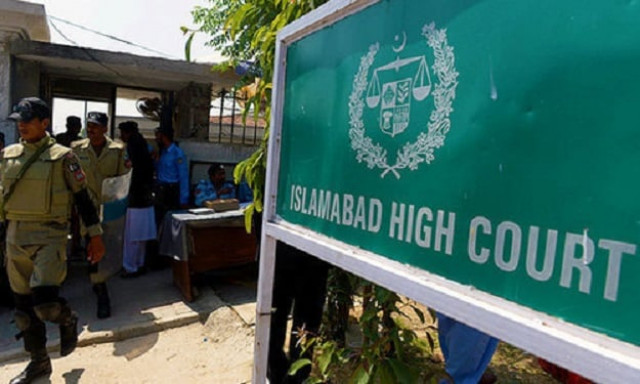
The Islamabad High Court has restrained authorities from evicting apartment owners of One Constitution Avenue until further notice, citing concerns over third-party rights and the building's lack of a completion certificate.
The Islamabad High Court has intervened in the ongoing dispute over the One Constitution Avenue building, halting the eviction of apartment owners until further notice. A division bench comprising Justice Muhammad Azam Khan and Justice Inaam Ameen Minhas heard intra-court appeals filed by several prominent individuals, including former air chief Mujahid Anwar Khan, former ICC president Ahsan Mani, and former Senate chairman Wasim Sajjad. The appellants challenged paragraph 30 of a single bench decision concerning the protection of third-party rights, arguing that their rights as apartment owners had not been adequately considered.
The court's decision to grant a stay on the eviction process has provided temporary relief to the apartment owners, who have been embroiled in a protracted dispute with the Capital Development Authority (CDA) over the building's lease and ownership rights. During the proceedings, the CDA counsel argued that the appeals were not maintainable, but the court chose to focus on the request for a stay, with Justice Inaam Ameen Minhas remarking that the full case would be heard at a later date.
The court also raised questions about the circumstances surrounding the apartment owners' occupation of the building, noting that they had begun living there without a completion certificate. Justice Khan expressed surprise that the CDA had allowed residents to move in without ensuring that the necessary certifications were in place, asking whether the authority had been "sleeping" on the job. The CDA counsel confirmed that the building had still not received its completion certificate, prompting the court to rule that no eviction of apartment owners shall take place until further orders.
The dispute over the One Constitution Avenue building has its roots in a 13.5-acre plot awarded to the BNP Group following an auction in 2005. Although the group has made some payments on the land, it has failed to meet its full financial obligations, with the CDA arguing that full ownership is conditional upon 100% payment of the land cost. The court's decision to halt the eviction process has added a new layer of complexity to the dispute, which has already been the subject of numerous legal challenges and appeals.
The apartment owners have maintained that they are innocent parties in the dispute, having purchased their apartments in good faith after the CDA approved the building plan and issued a no-objection certificate. They argue that the dispute is between the CDA and the developer, and that they should not be penalized for the developer's failure to meet its obligations. The court's decision to grant a stay on the eviction process has provided them with a temporary reprieve, but the ultimate outcome of the dispute remains uncertain.
In its detailed verdict, the court ruled that the buyers lack ownership rights, as the project's lease had been terminated and the proper legal processes had not been followed regarding the transfer of ownership. The court's decision has significant implications for the apartment owners, who face an uncertain future as the dispute continues to unfold. The case highlights the complexities and challenges of property development in Pakistan, where disputes over land ownership and lease agreements are common. As the case continues to make its way through the courts, the apartment owners can only wait and see what the future holds for them.