Pakistan's lost antiquities return to Islamabad Museum as part of 'Legacy Returns Home' exhibition showcasing cultural cooperation between US and Pakistan.
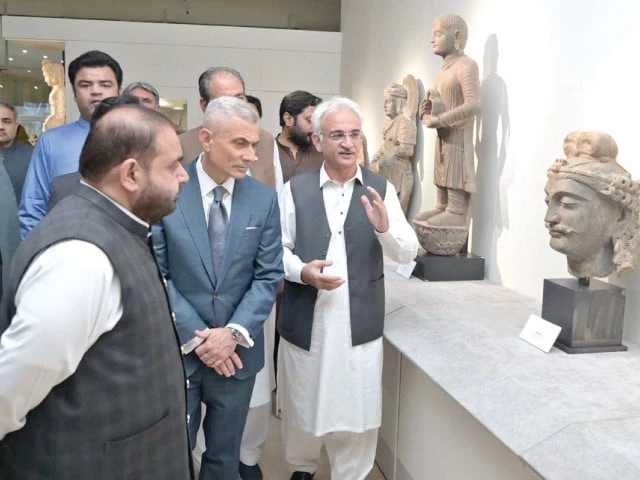
Beneath soft gallery lighting and behind carefully sealed glass cases, fragments of Pakistan’s lost past stood reunited with the land they once belonged to. Each artefact carried traces of vanished kingdoms, forgotten rituals, and civilisations that flourished thousands of years ago. The special exhibition 'Legacy Returns Home', inaugurated at the Islamabad Museum on Wednesday, brought together a remarkable collection of antiquities repatriated from the United States after being intercepted in illicit trafficking networks.
More than a ceremonial display, the exhibition highlights cultural cooperation between Pakistan and the US and the recovery of stolen heritage items. Spanning multiple historical periods, the displayed collection includes rare stone and stucco Buddhist sculptures, relic caskets, narrative reliefs of the Gandhara civilisation, a rare gold coin from the Indo-Greek period, terracotta figurines, and painted pottery dating back to 7,000 BC. These artefacts were intercepted by US Homeland Security authorities and later handed over to the Consulate General of Pakistan in New York under Article 7(b)(ii) of the UNESCO 1970 Convention and a bilateral agreement signed on January 30, 2024 between Pakistan and the United States.
Speaking at the inauguration, Federal Minister for National Heritage and Culture Aurangzeb Khan Khichi said the repatriation of priceless Pakistani antiquities from the United States reflected a deepening cultural partnership. He called the returned artifacts "a part of Pakistan's soul, history, and civilisational identity." Khichi emphasized that illicit trafficking of antiquities was a "crime against humanity" that deprived nations and future generations of their collective memory and identity.
The minister Pakistan, home to the Indus Valley Civilisation and the Gandhara artistic tradition, possesses one of the world's richest cultural legacies. He assured that the government remained committed to strengthening legal, institutional, and professional mechanisms for the preservation and recovery of stolen heritage, stressing that international cooperation was essential in combating the illicit trade in cultural property.
Assistant Secretary at the US Embassy in Pakistan S Paul Kapur, attending as guest of honour, said the United States celebrated 250 years of independence by successfully preserving its historical heritage. He bilateral relations with Pakistan remained strong across multiple sectors.
Director General of the Department of Archaeology and Museums Amanullah described the exhibition as a celebration of the return of priceless pieces of Pakistan's history and identity. He it would help raise public awareness about the impact of illicit antiquities trafficking, saying, "The exhibition is not just an event but a call to action for all stakeholders to protect our shared cultural heritage."
Since 2007, a total of 513 Pakistani cultural artifacts have been repatriated from the United States in different phases. These recoveries included items returned in 2007, 2021, 2023, and 2026.
The exhibition symbolises justice, international cooperation, and shared commitment to heritage protection. It serves as a reminder that safeguarding cultural treasures is not just the responsibility of individual nations but also an obligation for all humanity.