
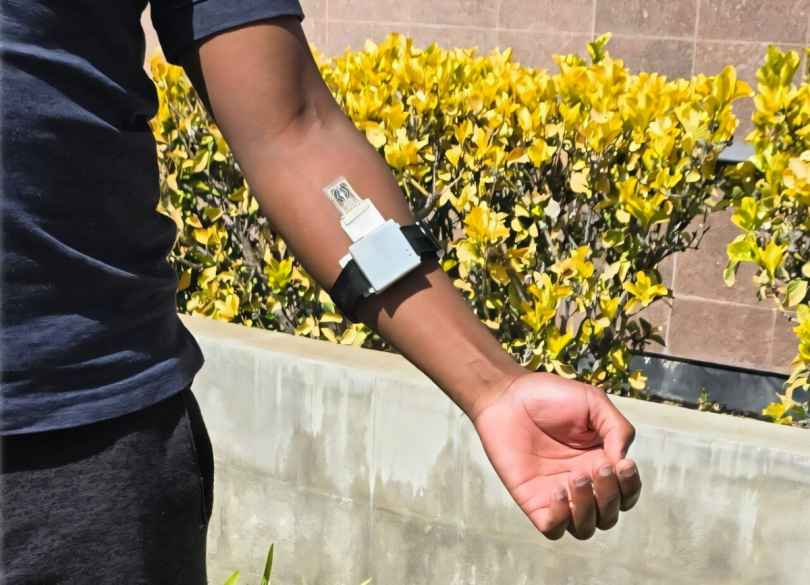
Researchers develop a wearable sweat sensor that monitors cortisol, glucose, lactate, and urea levels continuously for 21 days, offering a promising tool for chronic disease management and health monitoring.
A team of researchers at the University of California, Irvine has invented a wearable, wireless, and battery-free bioelectronic sensor that can monitor multiple biomarkers in human sweat for an extended period. The device, called the In-Situ Regeneratable, Environmentally Stable, Multimodal, Wireless, Wearable Molecular Sweat Sensing System, or IREM-W2MS3, can track cortisol, glucose, lactate, and urea levels simultaneously, providing valuable insights into stress response, metabolic activity, physical exertion, and kidney function.
The IREM-W2MS3 is worn as a flexible skin patch and paired with a standard Android smartphone or a custom wrist-watch-like reader. The system uses a low voltage to regenerate its sweat-sensing surfaces, allowing it to operate continuously over long periods without manual cleaning or replacement. This feature addresses one of the biggest challenges in long-term wearable biosensing, where sensor surfaces can lose performance after repeated measurements due to molecular binding.
According to Rahim Esfandyar-pour, the senior author of the study, the IREM-W2MS3 offers a robust and practical health monitoring platform that can support various applications, including chronic disease management, stress and mental health monitoring, sports performance optimization, and preventive medicine. The device can induce perspiration in wearers when needed, eliminating the requirement for strenuous physical activity to generate sweat samples.
The researchers tested the IREM-W2MS3 under varying pH and temperature conditions over a continuous 21-day period and demonstrated consistent sensing performance with no measurable signal degradation. The device's ability to track multiple biomarkers simultaneously with high precision makes it a promising tool for continuous health tracking. By monitoring cortisol, glucose, lactate, and urea levels together, the IREM-W2MS3 can provide a broader picture of a person's health, enabling early diagnosis and consistent health monitoring.
The IREM-W2MS3 has the potential to revolutionize the field of wearable biosensing, offering a durable, easy-to-use, and highly reliable platform for monitoring multiple biomarkers. Its applications are numerous and varied, ranging from chronic disease management to sports science and performance optimization. As the device continues to evolve, it may become an essential tool for individuals seeking to monitor their health and well-being in real-time.
The development of the IREM-W2MS3 highlights the growing importance of wearable technology in healthcare. With its ability to track multiple biomarkers continuously, the device can provide valuable insights into human health, enabling individuals to take proactive steps towards preventing and managing diseases. As the field of wearable biosensing continues to advance, we can expect to see more innovative devices like the IREM-W2MS3 that can transform the way we approach healthcare and wellness.
In conclusion, the IREM-W2MS3 is a groundbreaking wearable sweat sensor that has the potential to revolutionize the field of healthcare. Its ability to track multiple biomarkers continuously for 21 days makes it an essential tool for chronic disease management, stress and mental health monitoring, and preventive medicine. As researchers continue to refine and improve the device, we can expect to see significant advancements in the field of wearable biosensing, enabling individuals to take control of their health and well-being like never before.


