
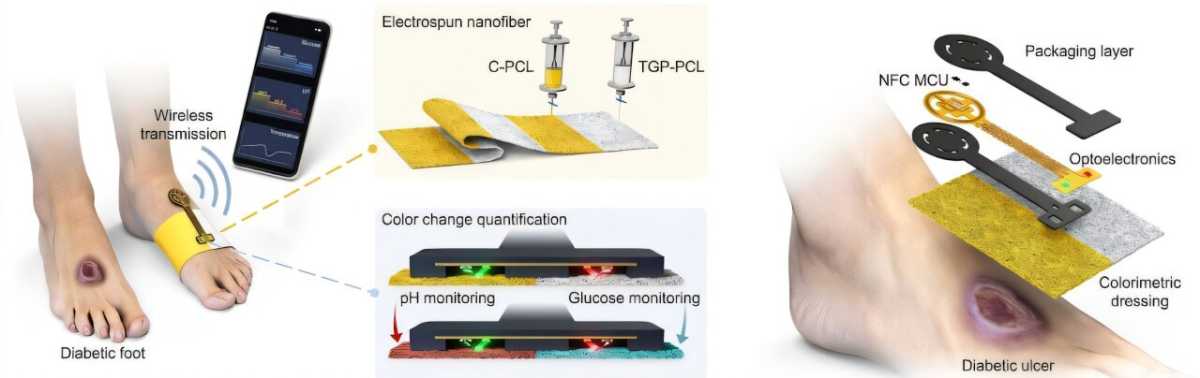
A research team at the Korea Advanced Institute of Science and Technology (KAIST) has developed a groundbreaking smart dressing patch that could revolutionize diabetes care by providing real-time diagnostic capabilities. The patch combines an optoelectronic sensor with a functional nanofiber dressing to monitor wound conditions, including glucose concentration, acidity, and temperature changes.
The conceptual diagram illustrates the multimodal colorimetric dressing and optoelectronic sensor system designed for diabetic ulcer management. This innovative technology allows patients to check their condition using only a smartphone app, eliminating the need for invasive procedures or repeated blood sampling.
The patch's design includes an LED embedded in the dressing that is connected to a photodiode on the opposite side of the device. When light reflects off the dressing and passes through the photodiode, it generates an electrical signal that can be analyzed by the smartphone app. This method offers more accurate data than traditional imaging techniques because it is less affected by changes in surrounding lighting.
The research team utilized near-field communication (NFC) technology to power the patch without a separate battery. When placed near the sensor, the device receives wireless power and transmits real-time wound condition data directly to patients' smartphones. This feature enables immediate monitoring and prompt action from both patients and medical staff.
In clinical trials, this smart dressing has shown significant potential for early detection of diabetic foot ulcers and other complications. The color-changing nanofiber dressing provides intuitive visual signals while the optoelectronic system offers quantitative electronic data. Together, these features reduce patient burden and improve overall management of diabetes-related wounds.
Distinguished Professor Inkyu Park from KAIST emphasized that this technology marks a major advancement in diabetic care: "Research aimed at reducing finger pricking for blood glucose testing has led to breakthroughs like this smart dressing patch." He further stated, "This platform can be expanded to develop non-invasive diagnostic technologies for various chronic diseases."
The development of such a device holds immense promise for improving the quality of life for diabetes patients by enabling continuous monitoring and management without invasive procedures. As Professor Park noted, "It's not just about reducing pain; it's about preemptively diagnosing complications before they become severe." This technology could potentially end the fear associated with diabetic foot amputation.
The study was published in Advanced Functional Materials and involved co-first authors KAIST Dr. Seokjoo Cho and Professor Ji-Hwan Ha from Hanbat National University. The research team also collaborated with researchers from the Korea Institute of Machinery & Materials and California Institute of Technology (Caltech).
This innovative smart dressing patch represents a significant step forward in diabetes care, offering real-time monitoring capabilities that could transform how patients manage their condition. As medical technology continues to advance, such breakthroughs are crucial for improving patient outcomes and reducing healthcare costs associated with chronic diseases like diabetes.


