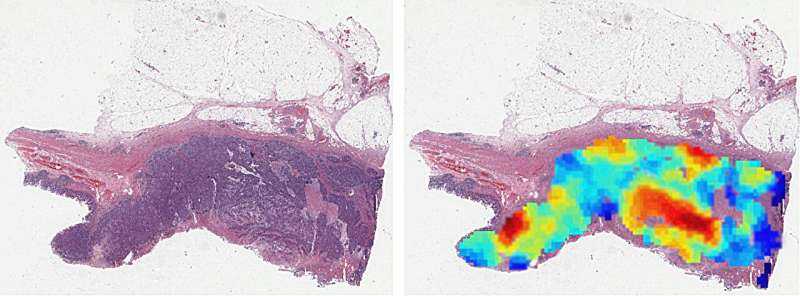
Researchers from the Faculty of Information Technology at the University of Jyväskylä have developed an advanced AI model to enhance the analysis of colorectal cancer samples, improving diagnosis accuracy and efficiency.
Researchers at the Faculty of Information Technology at the University of Jyväskylä have made significant strides in the field of medical diagnostics by developing a new artificial intelligence (AI) model. This innovative tool is designed to accelerate the analysis of colorectal cancer samples while also predicting the functionality of cells' DNA repair mechanisms.
The AI model, which was published in Computer Methods and Programs in Biomedicine, has shown promising results in shortening diagnosis times, reducing costs associated with traditional methods, and improving overall accuracy. The research was conducted in collaboration with the Central Finland Welfare Region, highlighting a successful partnership between academia and healthcare providers.
By leveraging advanced computational techniques, this AI model can process large volumes of data more efficiently than conventional methods. This not only expedites the diagnostic process but also ensures that medical professionals have access to precise information about the state of cancer cells' DNA repair mechanisms. Such insights are crucial for developing personalized treatment plans and improving patient outcomes.
The collaboration between the University of Jyväskylä and the Central Finland Welfare Region underscores a commitment to advancing healthcare through technological innovation. This partnership aims to bring cutting-edge AI solutions directly into clinical practice, ultimately benefiting patients by providing faster and more accurate diagnoses.
In conclusion, this new AI model represents a significant step forward in colorectal cancer research and diagnosis. Its potential to revolutionize the field is immense, offering not only improved accuracy but also enhanced efficiency in handling complex medical data. As such, it holds great promise for transforming how healthcare providers approach cancer diagnostics in the future.