
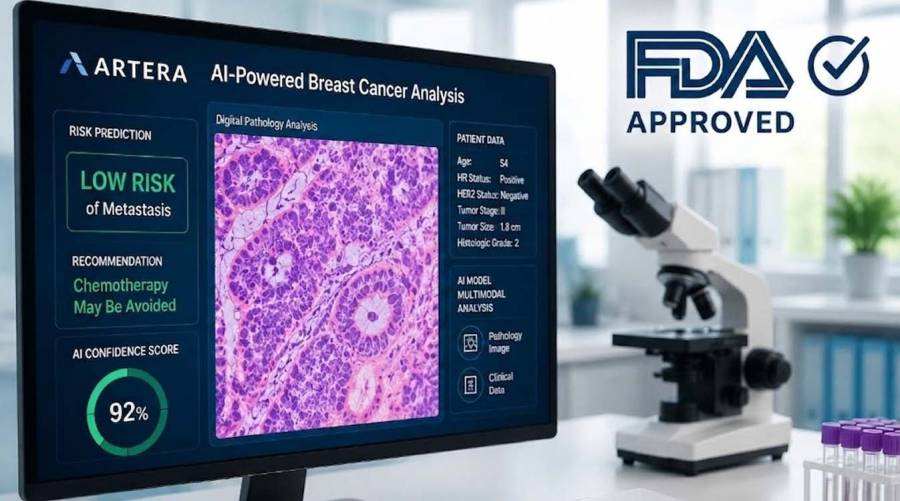
The U.S. FDA has cleared the first AI-powered digital pathology tool to help guide chemotherapy decisions for early-stage breast cancer patients. Learn more about this groundbreaking technology.
In a major breakthrough for precision oncology and artificial intelligence-driven healthcare, the U.S. Food and Drug Administration (FDA) has approved the ArteraAI Breast test. This innovative tool is designed to predict the likelihood of cancer metastasis and recurrence in patients with early-stage hormone receptor-positive (HR+) and HER2-negative invasive breast cancer—a common form of the disease worldwide.
Healthcare experts believe this approval could significantly shift treatment strategies, enabling physicians to identify which patients may benefit from chemotherapy and which can safely avoid its toxic side effects. According to Artera, the AI-driven platform analyzes digitized pathology slides alongside clinical data to estimate a patient's risk of distant metastasis. The multimodal artificial intelligence model was trained using clinical trial data from over 8,500 breast cancer patients.
Using this information, the system classifies patients into low-risk or high-risk groups based on their likelihood of cancer recurrence or spread. Experts argue that this could help oncologists make more informed treatment decisions while reducing overtreatment in lower-risk cases.
Dr. Calvin Chao, vice president of medical science at Artera, emphasized, "Patients and clinicians need to understand their risks for recurrence and decide which treatments will be the most effective, thereby avoiding both undertreatment and overtreatment."
The FDA approval is particularly significant given that breast cancer remains one of the world's most significant health challenges. According to global estimates from 2022, approximately 2.3 million women were diagnosed with breast cancer worldwide, while around 670,000 deaths were linked to the disease.
Currently, many treatment decisions rely on genomic tests such as Oncotype DX, which can estimate recurrence risk and determine whether chemotherapy may provide additional benefit. However, these tests are expensive, require several weeks for processing, and may not always be immediately accessible.
The newly approved AI model could potentially reduce delays and simplify treatment planning by using already available pathology images and clinical information. Dr. Richard Reitherman, a board-certified radiologist and medical director of breast imaging at MemorialCare Breast Center in California, described the technology as a potential advancement in oncology decision-making.
"Using immediately available clinical and histopathologic features to assign patients into low and high-risk metastasis groups without the costs and time delays associated with current methods is a significant breakthrough," he explained.
Experts say AI may help doctors make earlier treatment decisions, particularly in situations where chemotherapy decisions are unclear. One of the biggest benefits could be reducing unnecessary chemotherapy exposure in lower-risk patients. Chemotherapy can cause serious physical and emotional side effects, including fatigue, neuropathy, increased infection risk, fertility complications, nausea and vomiting, and long-term cardiovascular effects.
Dr. Donna McNamara, a breast medical oncologist at Hackensack University Medical Center in New Jersey, described the FDA clearance as a major milestone in personalized cancer care. "The potential to spare low-risk patients from significant toxicities of chemotherapy is a major advantage," she said.
Despite the excitement surrounding the technology, experts stress that long-term clinical validation remains essential before widespread adoption. AI-based tools must demonstrate consistent accuracy across diverse patient populations and show outcomes comparable to existing gold-standard testing methods.
Some oncologists have emphasized the importance of understanding how AI models generate risk assessments before relying heavily on them for treatment decisions. The FDA clearance reflects the growing role of artificial intelligence in modern medicine, particularly in radiology, pathology, and oncology. Healthcare analysts predict that future AI applications may further transform cancer screening, prognosis assessment, and treatment planning.
For breast cancer patients, specialists believe the emergence of AI-guided treatment tools could represent an important step toward more precise, individualized, and less invasive care.


