
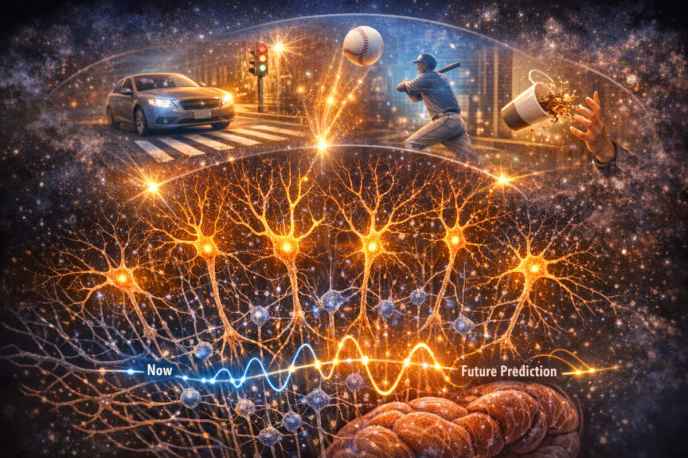
Researchers discover unique neurons in the cerebellum that predict the timing of future events, shedding light on the brain's statistical reasoning and prediction processes.
The human brain is constantly making predictions about future events based on past experiences and perceptions of the environment. This predictive process is described by a mathematical framework known as Bayesian inference, where probabilities about future events are updated as new evidence becomes available. Recent research has suggested that the mammalian brain makes predictions in a similar manner, by continuously estimating what will happen next based on new sensory information.
A team of researchers at Radboud University and the Erasmus University Medical Center in the Netherlands conducted a study on mice to better understand the neural circuits that represent these probability-based predictions. Their findings, published in Nature Neuroscience, suggest that the probability distributions of temporal events are learned by circuits in the cerebellum. The study also shows that statistical information about the expected timing of future events is encoded by large, unique neurons in the cerebellum, called Purkinje cells.
The researchers trained adult mice to expect a specific event, such as a puff of air on one of their eyes, at specific times after seeing a flash of light. They then recorded the activity of Purkinje cells in the cerebellum while the mice completed an eyeblink conditioning task. The results showed that these cells changed their activity patterns over time, as the mice learned new timing statistics. When the activity of these cells was disrupted, the mice no longer blinked in expectation of future air puffs, suggesting that Purkinje cells play a crucial role in generating predictive behavior based on prior knowledge of stimulus statistics.
The study's findings have significant implications for our understanding of statistical reasoning and future event prediction in the brain. The discovery of a specific signal associated with the prediction of event or stimulus timing could lead to further research on the neural processes and circuits involved in these predictions. According to Devika Narain, senior author of the paper, the brain takes the probability of events into account even for simple motor behaviors and generates internal signals to compensate for an unpredictable world.
The researchers' work could soon inspire more studies aimed at further examining the prediction-related neural processes and circuits they identified. Eventually, their findings could help improve existing models of how the brain supports statistical reasoning and future event prediction. As Narain noted, the team is now interested in discovering how this internal compensation mechanism works and how the brain learns to counteract unpredictability in the external world.
The study's results highlight the importance of the cerebellum in encoding and storing statistical predictions about future events. The discovery of unique neurons in the cerebellum that predict the timing of future events sheds new light on the brain's ability to make predictions and adapt to changing environments. Further research on this topic could lead to a deeper understanding of the neural mechanisms underlying statistical reasoning and prediction, with potential applications in fields such as neuroscience, psychology, and artificial intelligence.
In conclusion, the research on cerebellum neurons and their role in predicting future event timing has significant implications for our understanding of brain function and behavior. The study's findings demonstrate the complexity and adaptability of the human brain, and highlight the importance of continued research into the neural mechanisms underlying statistical reasoning and prediction. As our understanding of the brain and its functions continues to evolve, we may uncover new insights into the intricate processes that govern our perceptions, behaviors, and interactions with the world around us.


