
A study reveals the presence of cancer-causing viruses in Texas wastewater, offering new avenues for public health monitoring.
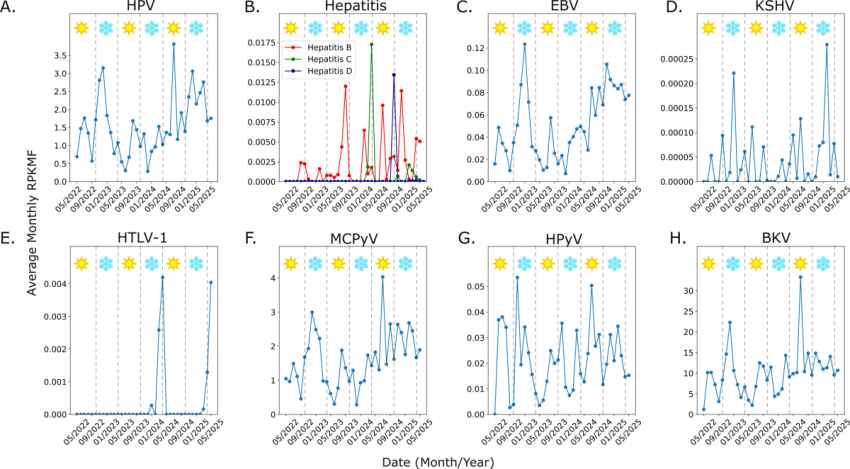
A comprehensive study published in Applied and Environmental Microbiology has detected a range of oncogenic viruses in Texas wastewater samples over three years. The research, conducted by Baylor College of Medicine and the University of Texas Health Science Center at Houston, utilizes hybrid-capture genetic sequencing to monitor viral signals without identifying individuals personally. This approach allows for the identification of more than 3,000 known human viruses, including cancer-causing types such as HPV, hepatitis B and C viruses, EBV, KSHV, MCPyV, HPyV, and BKV.
The study analyzed wastewater samples collected from over 40 sites across 16 cities in Texas between May 2022 to May 2025. The findings indicate that the abundance of multiple oncogenic viruses increased significantly over this period. Notably, HPV, EBV, and certain polyomaviruses showed clear upward trends, with particularly sharp increases after 2024.
Dr. Anthony Maresso, professor of molecular virology and microbiology at Baylor College of Medicine, emphasized the importance of these findings: "Oncogenic viruses can cause about one in five cancers worldwide, including cervical, throat, liver, and several types of blood cancers. Our study provides a new tool for tracking these viruses in communities without compromising individual privacy."
The researchers also detected all nine HPV types targeted by the current Gardasil 9 vaccine, demonstrating that wastewater monitoring can track vaccine-preventable viruses effectively.
Dr. Justin Clark, assistant professor of molecular virology and microbiology at Baylor College of Medicine, highlighted the significance of this approach: "By analyzing viral signals in wastewater, we can identify which specific virus types are circulating and how common they are relative to each other over time."
Clark one possible explanation for the observed trends is increased travel and interpersonal contact during vacation periods. Additionally, he suggested that relaxation of COVID-related social distancing measures may have contributed to higher transmission rates of sexually transmitted oncogenic viruses like HPV.
The study's findings underscore the potential utility of wastewater-based epidemiological monitoring in understanding viral interactions with human populations. This approach could help assess vaccination program effectiveness and identify areas where interventions might be needed most.
Moving forward, this research opens new possibilities for improved public health interventions aimed at preventing and managing cancer-causing viruses. As Dr. Maresso concluded: "Our study proves that cancer-causing viruses can be tracked in wastewater and provides valuable insights into their dynamics within communities."
Publication details: Harihara Prakash et al., Detection, persistence, and rising prevalence of oncogenic viruses revealed by wastewater metagenomics, Applied and Environmental Microbiology (2026).
DOI: 10.1128/aem.00547-26
Journal information: Applied and Environmental Microbiology
Key medical concepts: Human papillomavirus Wastewater-Based Epidemiological Monitoring Papillomavirus Vaccine, Human
Clinical categories: Oncology Infectious diseases Laboratory medicine Common illnesses & Prevention Preventive medicine


