
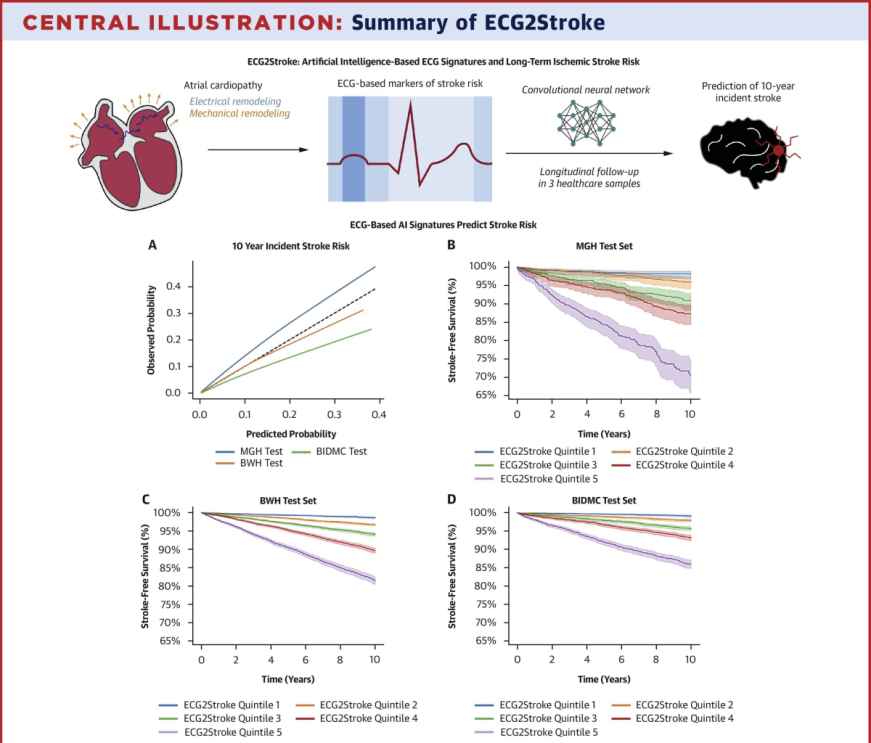
Researchers develop AI model to predict 10-year stroke risk using a single 10-second cardiology test, potentially identifying patients for intensive prevention efforts.
A research team has developed an artificial intelligence model that can predict the risk of a stroke up to 10 years into the future using a single 10-second cardiology test. The model, known as ECG2Stroke, uses data from electrocardiograms (ECGs) to identify subtle waveform patterns that are associated with an increased risk of stroke. This innovative approach has the potential to revolutionize the way doctors identify and prevent strokes, which are a leading cause of death and disability worldwide.
The ECG2Stroke model was developed using data from over 200,000 patients at Massachusetts General Hospital, Brigham and Women's Hospital, and Beth Israel Deaconess Medical Center. The researchers found that the model could consistently predict a stroke up to 10 years in the future with performance similar to a validated clinical risk score. The model was particularly accurate at predicting strokes caused by blood clots that form in the heart and travel to the brain, which are preventable with blood thinners.
The researchers believe that the ECG2Stroke model could be a valuable tool for doctors to identify patients who are at high risk of stroke and prioritize them for intensive prevention efforts. The model could also be used to drive future research into the mechanisms of stroke and the development of new treatments. According to co-lead author Rahul Mahajan, "Existing tools to identify which patients are at the highest risk of stroke often require cumbersome clinical score calculations, are not easily scalable, and are therefore not used widely in routine practice." The ECG2Stroke model offers a simpler and more efficient way to predict stroke risk, using a test that is already widely available and commonly used.
The ECG2Stroke model uses deep learning algorithms to analyze the data from ECGs and identify patterns that are associated with an increased risk of stroke. The model takes into account a patient's age and sex, as well as the data from the ECG, to make its predictions. The researchers found that features related to detecting dysfunction of the heart's atria, the upper chambers that receive blood from the body, had some of the largest influence on the model's predictions. This suggests that the model is able to identify subtle changes in the heart's electrical activity that are associated with an increased risk of stroke.
The development of the ECG2Stroke model is an important step forward in the prevention and treatment of stroke. According to co-senior author Shaan Khurshid, "If confirmed after prospective, real-world studies, tools like this could identify which patients should be prioritized for intensive prevention efforts." The model has the potential to save lives and reduce the burden of stroke on individuals and society. Further research is needed to validate the model and determine its effectiveness in clinical practice, but the results so far are promising and suggest that the ECG2Stroke model could be a valuable tool in the fight against stroke.


