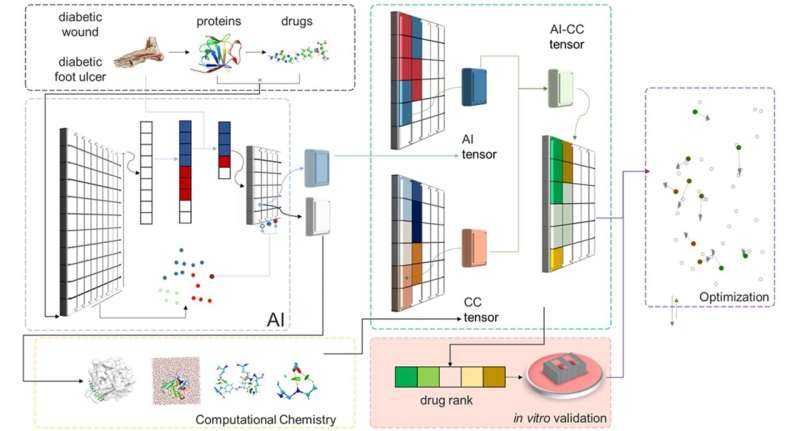
The development of effective treatments for diabetic wound healing has long been a challenge for medical researchers. However, a recent breakthrough by researchers from the National University of Singapore (NUS) may offer new hope for patients. The team has created an innovative AI-guided workflow that leverages the power of artificial intelligence and molecular simulations to identify potential drug candidates.
This cutting-edge approach has already yielded promising results, with folic acid emerging as a top candidate for diabetic wound healing. Folic acid, a common vitamin, has been found to have potential therapeutic benefits in the treatment of diabetic wounds. The AI-guided workflow used by the researchers combines machine learning algorithms with molecular simulations to analyze the interactions between small molecules and proteins involved in wound healing.
The use of AI in drug discovery has the potential to revolutionize the field, enabling researchers to quickly and efficiently identify potential drug candidates. By analyzing vast amounts of data and simulating complex molecular interactions, AI can help researchers to identify patterns and connections that may not be immediately apparent. This can significantly accelerate the drug discovery process, allowing researchers to bring new treatments to market more quickly.
The identification of folic acid as a potential treatment for diabetic wound healing is a significant finding, and one that highlights the potential of AI-guided drug discovery. Further research is needed to fully explore the therapeutic potential of folic acid, but the results so far are promising. As the field of AI-guided drug discovery continues to evolve, it is likely that we will see many more innovative treatments emerge, offering new hope for patients with a range of diseases and conditions.