

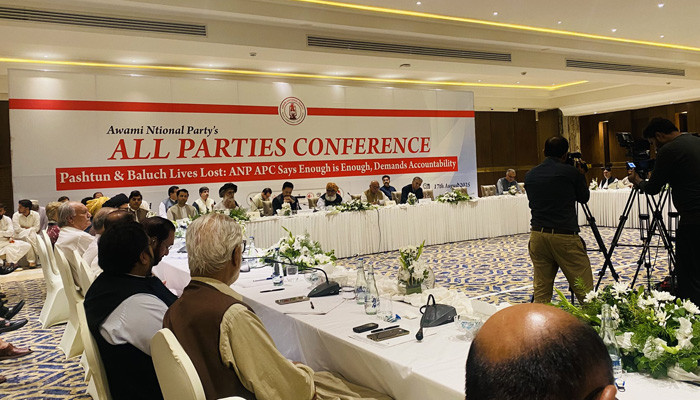
All Parties Conference Ends in Discord Over Joint Declaration
An All Parties Conference (APC) convened by the Awami National Party (ANP) concluded on Sunday with disagreements, as the ruling Pakistan Muslim League-Nawaz (PML-N) and Pakistan Peoples Party (PPP) chose not to sign the joint declaration. This exposed significant political divides despite appeals for solidarity on challenges confronting Khyber Pakhtunkhwa and Balochistan.
The conference, organized by ANP President Aimal Wali Khan and attended by representatives from 19 parties, aimed to emphasize the deteriorating law and order situation, exploitation of resources, and political issues in the merged districts and Balochistan.
However, when the declaration was presented, Senator Irfan Siddiqui, the PML-N parliamentary leader in the Senate, and Nayyar Hussain Bukhari, the PPP Secretary General, declined to endorse it, highlighting divisions between the two government allies and opposition factions.
PML-N and PPP Defend Their Positions
Senator Irfan Siddiqui defended their position, stating that the two parties disagreed with certain demands and, therefore, could not support the declaration. He urged leaders to move past grievances, emphasizing that “criticizing Punjab will not resolve national issues” and instead advocating for a comprehensive national discussion.
He emphasized that the Constitution is for all citizens and promised that no one would be permitted to undermine it. “If martial law had been imposed, there would not have been this freedom to speak in an APC in Islamabad,” he added.
He lauded the armed forces as protectors of the nation, mentioning that the Pakistan Army had overcome an enemy significantly larger in size.
Siddiqui also appealed for all parties to commit to the Constitution and democracy, irrespective of their political grievances or disagreements.
Condemning sectarian violence in Balochistan, he pointed out that civilians were targeted after their identification cards were checked. “Yet no one in Punjab spoke against Baloch or blamed them. Punjabis and all Pakistanis know these were not the acts of ordinary Baloch,” he said.
He further reminded everyone that both houses of parliament represented the entire federation and that no legislation concerning any province could be enacted without the approval of its representatives.
PPP’s Bukhari expressed similar concerns, defending his party’s role in safeguarding the continuity of parliament and emphasizing that any discussion must remain within the bounds of the 1973 Constitution.
“When no party had a majority and no one was willing to form a government, the PPP stepped forward in the national interest to safeguard democracy,” he said.
He dismissed calls for a “new social contract” as a departure from the consensus document, while rejecting any possibility of talks with those acting as proxies of India and carrying out terrorism in Pakistan. “Dialogue must take place within the framework of the 1973 Constitution. Talking about a new social contract means deviation from that Constitution,” he remarked.
JUI-F Chief’s Remarks
Earlier, JUI-F chief Maulana Fazlur Rehman set the tone of the APC with strong remarks, claiming that armed groups were diverting 10% of government funds in tribal districts, leaving businesses vulnerable to extortion.
Fazl stated that the natural resources of Khyber Pakhtunkhwa and Balochistan belonged to the people, and if multinational companies invested, the resulting jobs and profits should benefit local communities. “There are laws in place under which investment can be made, but rather than empowering locals, institutions are more focused on control,” he remarked.
He also criticized the revival of jirgas in the former FATA almost a decade after the merger, arguing that promises made to the tribes had not been kept. He urged political forces to stay vigilant, warning that Pakistan’s parliamentary system was losing credibility.
“Our parliamentary and political framework has become questionable. Stealing the public mandate was never acceptable and will never be acceptable,” he said.
On security, Fazl dismissed the National Action Plan as merely a declaration without legal authority and called instead for a “National Economic Plan” to reassure citizens that resources and profits would benefit them directly.
The JUI-F chief emphasized that dialogue was the only way to address the underlying causes of unrest.
Touching on the issue of Afghan refugees, Fazl said forced repatriation, under current circumstances, was inappropriate. “Categories must be defined. Many Afghans have invested here for decades, while thousands have graduated as doctors and engineers from our institutions. They are our skilled human capital — we should not waste them. Students should at least be allowed to complete their education,” he added.
Meanwhile, ANP chief Aimal Wali Khan, the host of the conference, lamented that Khyber Pakhtunkhwa continued to suffer while other provinces progressed, pointing to displaced families in Waziristan and neglected resources in the province.
Qaumi Watan Party leader Aftab Ahmad Khan Sherpao cautioned against bypassing parliament through direct talks with the establishment, while Mohsin Dawar controversially called for a new Constitution based on equality.
In response, Bukhari reminded participants that the 1973 Constitution took 25 years to finalise and still enjoyed consensus, stressing that necessary changes must be pursued within its framework.
Declaration Demands
Despite the withdrawal by PML-N and PPP, the declaration adopted by the remaining parties demanded full implementation of the 18th Constitutional Amendment in its true spirit and called for an end to ongoing operations in Khyber Pakhtunkhwa (KP) and Balochistan. The APC voiced deep concern over the ongoing unrest, terrorism and denial of constitutional rights in Khyber Pakhtunkhwa and Balochistan, holding flawed past internal and external policies responsible for the current crisis.
ANP’s APC declaration stated that the participants condemned terrorism, extremism and violence in all forms, demanding an immediate halt to ongoing military operations in the provinces.
They also called for the establishment of a truth commission under judicial oversight to investigate human and financial losses caused by these operations.
The declaration stressed full implementation of the 18th Constitutional Amendment, enforcement of the National Finance Commission (NFC) Award, restoration of provinces’ rights over mineral resources, cancellation of illegal land allotments and protection of the historic rights of tribal people.
Other demands included restructuring the Levies Force in Balochistan on modern lines, transferring full authority to the civil administration in merged districts, ending enforced disappearances and releasing political prisoners.
The APC also called for lifting curbs on independent media and journalism, repealing discriminatory laws such as the 3-MPO and the Fourth Schedule, rehabilitating terrorism-affected areas, ensuring the return of internally displaced persons, and creating employment opportunities.
It further condemned the forced repatriation of Afghan refugees and urged the revival of Balochistan’s only agricultural university for academic activities.
Expressing sorrow over the devastation caused by recent floods and natural disasters in Khyber Pakhtunkhwa, the conference announced the cancellation of “Islamabad Peace March” earlier scheduled for August 23 under the National Peace Jirga, with a new date to be decided later through mutual consultation.
Reaffirming their commitment, the participants declared that Pakistan’s security, stability and development were only possible through the supremacy of the Constitution, equal rights for provinces and a transparent democratic process. All political forces vowed to continue their joint struggle toward these goals.
Comments (0)
No comments yet. Be the first to comment!
Leave a Comment