

Devastating Floods in Pakistan’s Mountainous Regions
Intense rainfall concentrated over limited areas within Pakistan’s mountainous terrain has resulted in widespread devastation, wiping out entire communities.
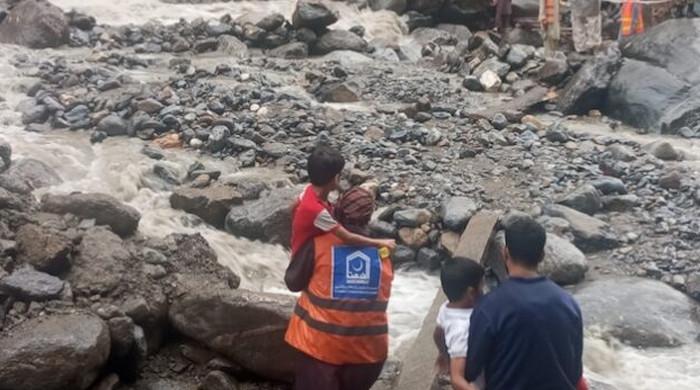
On August 15, the Buner district in Khyber Pakhtunkhwa (KP) province experienced an unusual weather event. The combination of glacial melt and heavy monsoon rains triggered floods that submerged villages under layers of mud and rock.
“I’ll never be able to forget what we encountered upon reaching the summit of the final hill—no signs of life, homes, or trees—just gray sludge and massive rocks,” recounted Amjad Ali, 31, a rescuer affiliated with Al-Khidmat Foundation, the charity wing of Jamaat-e-Islami. He was among the first to arrive at Bishonai village, where 90% of it had been washed away.
It took Ali and his group of 15 volunteers, including two paramedics, four hours to get to the once-forested village, now concealed beneath mud and rock.
Since June, northern valleys spanning Gilgit-Baltistan, Kashmir, and KP have been hit repeatedly by climate-related disasters. The National Disaster Management Authority (NDMA) has documented over 695 fatalities between June 26 and August 19, with 53% attributed to flash floods, 31% to house collapses, and approximately 8% to drowning.
“The weather is in a fury, and there’s no indication of improvement,” cautioned Sahibzad Khan, Director General of the Pakistan Meteorological Department.
He explained that reduced snowfall, which was also delayed until March, left insufficient time for snow accumulation.
“Temperatures began climbing steadily from April, with northern regions experiencing a surge of 7°–9°C in August,” he noted.
Khan advised against classifying the recent occurrences as “cloudbursts,” noting that these typically entail over 100 mm of rainfall within an hour. He emphasized that the unusual collapse of massive boulders in Buner was a sign of glacial disintegration.
“This outcome was unavoidable,” Khan stated. “Rising temperatures are taking a toll on glaciers. The presence of enormous boulders falling from the mountains indicates the breakdown of ancient glaciers.”
He cautioned that the warming of the Third Pole (the mountainous area west and south of the Tibetan Plateau) could cause the loss of ice towers, which are crucial to the Indus Basin.
As scientists predict prolonged effects, communities on the ground are struggling to cope with the immediate aftermath.
“People were in a state of shock, but from what little we gathered, it had been raining lightly throughout Thursday night (Aug 14). Then, around 8:30 am on Friday (Aug 15), a powerful torrent came rushing through, destroying everything in its path,” said rescuer Ali, speaking from Sawari Bazar, located 30 minutes from Bishonai village.
Every survivor shared the same account: the disaster struck suddenly, leaving no opportunity for rescue.
“I rescued a man from the sludge who had a broken leg and a missing eye,” Ali recounted. “He was the only surviving member of a family of 14. Their three-story home was gone.”
He added, “Every survivor had around a dozen family members missing that day.”
Despite his five years of experience leading rescue operations, Ali stated that he had never encountered such devastation. What exhausted the team wasn’t the eight-hour journey to and from Bishonai but the emotional burden of recovering bodies and helping injured survivors buried in the sludge.
With the support of over 100 volunteers, they managed to bury over 200 people, including men, women, and children, some headless and others missing limbs. More than 470 missing villagers were presumed dead. They returned home at 2 am, but their efforts were far from over.
The official death toll across Pakistan is 695: 425 in Khyber Pakhtunkhwa, 164 in Punjab, 32 in G-B, 29 in Sindh, 22 in Balochistan, 15 in Kashmir, and 8 in Islamabad—and the count keeps rising.
As of August 19, the NDMA reported nearly 958 injuries, with 582 in Punjab, 267 in KP, 40 in Sindh, 37 in Gilgit-Baltistan, 24 in Kashmir, 5 in Balochistan, and 3 in Islamabad.
Official statistics indicate that 17,917 individuals have been rescued, with over 14,000 from KP alone.
The floods have damaged 451 km of roads, 152 bridges, and 2,707 residences, with 833 completely destroyed, primarily in KP and G-B. Additionally, floods have claimed 1,023 livestock, with KP being the hardest-hit region.
The KP government has allocated PKR 800 million in relief funds for the affected districts and an additional PKR 500 million for Buner, which has suffered the most severe damage.
Similar to KP, Gilgit-Baltistan is struggling with a comparable climate-related catastrophe involving flash floods.
“No region in G-B has been spared,” stated Khadim Hussain, who heads the region’s Environmental Protection Agency. He cited widespread devastation of farmland, homes, hotels, restaurants, and entire riverbank villages. Multiple villages remain isolated due to bridge collapses and are experiencing severe shortages of drinking water.
The situation intensifies when the Karakoram Highway, G-B’s primary link to the rest of the country, is obstructed. “It has been flooded numerous times in just ten days,” he stated. Glacier collapses and district-wide floods have submerged portions of the highway, leaving travelers stranded for up to 12 hours.
Essential services have also ceased to function. Gilgit, the region’s capital, has been without electricity for three days. “The main hydropower station has sustained severe damage, and smaller micro-hydro units have been washed away,” Hussain added. Communication networks are also disrupted.
Hamid Mir, a coordinator with WWF Pakistan who has been studying weather patterns for over a decade, clarified that warmer air retains more moisture.
“With each 1°C rise in temperature, air can hold 7% more water vapor, intensifying rainfall,” he explained.
Rapid glacier melt increases humidity in local microclimates, feeding convective clouds, which cause brief, heavy rainfall events, including cloudbursts, he noted.
“What we are currently observing is just the beginning,” Mir cautioned, explaining that G-B’s steep terrain accelerates condensation and torrential downpours.
Mir also emphasized that deforestation is a significant factor. Native pine and oak trees at high altitudes have been replaced with moisture-releasing broadleaf species, disrupting weather patterns. Northern Pakistan is home to 45% of the country’s forests and 60% of its coniferous cover, but deforestation has diminished natural carbon and moisture sinks.
“If we can halt the timber mafia’s destruction of our mountain slopes, there is still a chance,” stated PMD’s Khan.
Babajan, the president of the Awami Workers Party’s G-B chapter, claimed that illegal timber trade continues with the “implicit support of government and security agencies.” He urged regional climate action: encouraging electric vehicles, decreasing the use of fossil fuels, and rethinking construction methods that harm the environment.
He also attributed resource depletion to excessive mining and mountain blasting. “These resources are finite, and we must only take what is essential.”
Mir concurred with Babajan’s worries, citing Buner’s transformation: formerly renowned for its stream fish, it now lacks clean drinking water due to the expansion of the marble industry. “This is a clear illustration of how merciless development and unchecked industrialization can devastate once-pristine landscapes,” he said.
Dr. Ghulam Rasul, the former Director General of the PMD, stressed the pressing need for better early warning systems, enhanced district-level disaster management, and heightened community awareness of climate disasters, using both regional and global best practices.
“We urgently require an elected and operational local government, which was abolished two decades ago,” stated Safiullah Baig, 60, a member of Progressive Gilgit Baltistan, a widely followed progressive social media page on G-B that addresses common people’s issues, human rights violations, gender discrimination, and issues pertaining to colonial governance, climate change, and land grabbing.
“The bureaucrats governing us are not from this region, do not understand our geography or culture, and lack empathy,” he said.
“As always, the floods will provide them with an ideal opportunity to profit by soliciting funds both locally and internationally while highlighting our suffering,” he noted. “The aid rarely reaches those who need it the most.”
Sobia Kapadia, a climate resilience expert, stated that it was unfair to attribute the blame solely to climate change, given events such as cloudbursts and their increased intensity.
Speaking to IPS from London, she stated, “Fragility is intensified by everything from isolated development strategies to poor management, governance shortcomings, shortsightedness, and pervasive corruption.”
Kapadia, who has worked extensively in Pakistan following the 2010 ‘super’ floods, stated that land-use management plans were neglecting the health of ecosystems, and large-scale infrastructure projects were putting the most at-risk vulnerable populations in grave danger.
She stated that these occurrences provide a critical opportunity to transform crises into resilience, providing “us with a chance to safeguard our future” from ever-more-intense climate shocks.
EPA-GB’s Hussain, in agreement with Kapadia, stated that the toughest but most crucial decision for the provincial governments is to remove encroachments along the rivers. He emphasized the necessity of coordinated multi-agency action and, above all, strong political will, stating, “Illegally built structures must be dismantled to allow floodwaters a natural path and protect lives and property.”
“The solution goes beyond technical fixes; Pakistan needs deep systemic change and transformative adaptation to effectively confront these growing climate crises and termed it a whole-of-society approach integrating policy reforms, cross-sectoral collaboration and locally led adaptation, rooted in the context of indigenous knowledge,” Kapdia agreed.
Babajan concurred that the crisis is man-made and fixable. “We must focus on prevention, identifying local solutions before damage occurs. We must draw on the knowledge and technologies of our elders to build resilience.”
Comments (0)
No comments yet. Be the first to comment!
Leave a Comment