

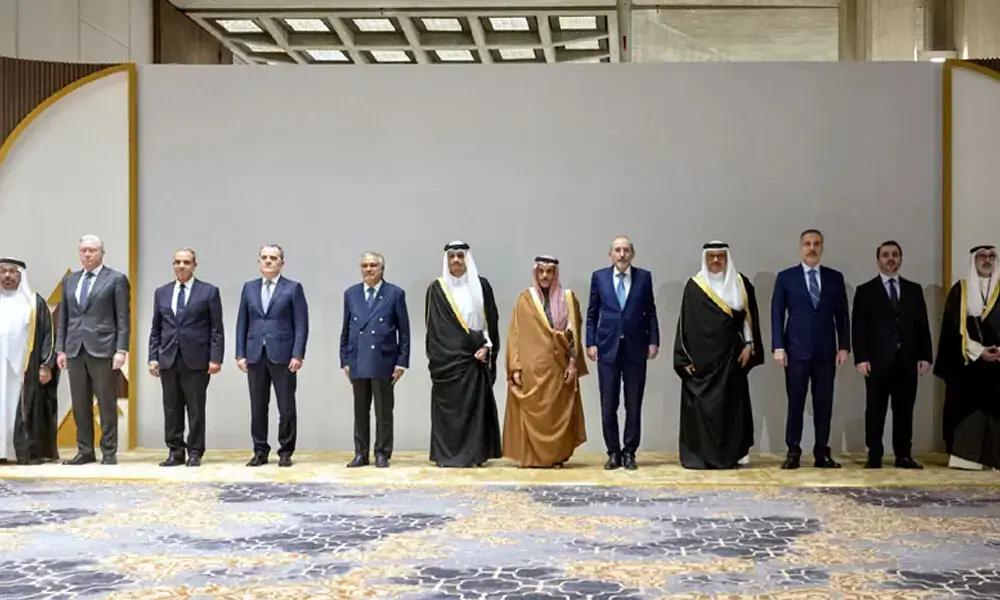
Foreign ministers from across the Arab and Islamic world gathered in Riyadh this week to issue a collective demand for Iran to immediately stop its military strikes and provocative behavior toward neighboring nations. The high-level meeting concluded on Thursday with a unanimous call for Tehran to respect international boundaries and cease any actions that threaten regional stability. Representatives from twelve countries, including Saudi Arabia, Pakistan, and Turkey, emphasized that the current cycle of aggression must end to prevent further escalation in an already volatile region. This diplomatic push aims to hold Iran accountable for its recent involvement in various cross-border conflicts.
During the two-day session, the ministers specifically pointed to the need for Iran to follow United Nations Security Council Resolution 2817. This international mandate requires an unconditional end to the financing and arming of various militia groups that operate within Arab territories. The ministers argued that Iran is currently pursuing its own strategic goals at the direct expense of its neighbors’ safety and sovereignty. By backing these armed groups, the participants claimed that Tehran is actively undermining the peace of the entire Middle East and surrounding areas.
The joint statement also highlighted grave concerns regarding global trade routes and the safety of international shipping. The diplomatic group warned Iran against making any threats or taking actions that could block the Strait of Hormuz or endanger vessels in the Bab al-Mandab strait. These waterways are essential for the global economy, and any disruption could have catastrophic financial consequences far beyond the region. Protecting maritime security was framed as a non-negotiable requirement for maintaining peaceful relations between Iran and the rest of the world.
A significant portion of the discussion focused on the physical damage caused by recent drone and ballistic missile strikes. The ministers condemned the targeting of civilian sites, such as desalination plants, airports, and residential buildings, stating that these attacks have no justification under any circumstances. They noted that these strikes have not only hit Gulf nations but have also reached into Jordan, Azerbaijan, and Turkey. The group reaffirmed that every nation has a fundamental right to defend itself under the United Nations Charter when its people and infrastructure come under fire.
Looking ahead, the ministers made it clear that any future cooperation or improvement in diplomatic ties with Iran depends entirely on its behavior. They stressed that Tehran must prove it can respect the sovereignty of other states and stop using its military power to intimidate its neighbors. The representatives also expressed their continued support for the stability and territorial integrity of Lebanon during these tense times. For now, the focus remains on whether Iran will heed these warnings and take the first steps toward de-escalation by complying with international law.
Comments (0)
No comments yet. Be the first to comment!
Leave a Comment