

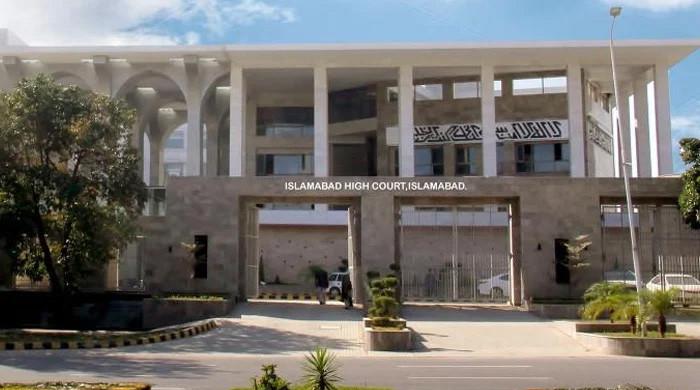
IHC Judges Voice Concerns Over Judicial Practices Ahead of Full Court Meeting
ISLAMABAD: Prior to a scheduled full court session, Justices Babar Sattar and Sardar Ejaz, both members of the Islamabad High Court (IHC), have communicated with IHC Chief Justice Sardar Muhammad Sarfraz Dogar to express their concerns regarding perceived judicial irregularities.
Chief Justice Dogar convened a full court assembly this Tuesday, coinciding with the commencement of the new judicial year, slated for today, Wednesday. Every judge within the IHC has been duly notified and directed to be present.
As the full court gears up for its 2 PM assembly, the aforementioned IHC justices have advocated for the inclusion of supplementary discussion points in the meeting’s schedule. Their request emphasizes worries pertaining to the assignment of cases, executive decisions, and the degree of openness inside the judicial institution.
Justice Sattar’s four-page correspondence probes whether the IHC’s judicial members presently hold the conviction that they are upholding their mandated constitutional duties, and furthermore, if the populace views them as guardians of their inherent rights.
“Has the IHC endeavored to fortify the district judiciary as an autonomous entity? Deficiencies in transparency plague the creation of duty rosters and the scheduling of hearings. In our rulings, we consistently remind officials that they are neither monarchs nor are their authorities limitless,” the letter articulates.
The justices underscore their apprehension that seasoned judicial figures are reportedly being overlooked, while supplementary justices are being entrusted with cases. The communication questions, “In the execution of administrative prerogatives, should justices and the chief justice bear in mind that they are public servants, not absolute rulers?”
The letter further critiques the administrative office’s purported reluctance to disseminate cause lists in particular instances, asserting that this trend undermines the judiciary’s autonomy.
Instances are cited where the formulation of rosters has allegedly deprived Justice Sattar and other judges of single-member benches. It also points out that experienced judges have been omitted from the administrative committee, contravening established norms, while supplementary and transferred judges have been incorporated.
An additional source of disquiet stems from the obligatory prerequisite for judges to secure no-objection certificates (NOCs) when planning international travel.
“Institutions require decades to cultivate, yet can be dismantled swiftly,” the letter cautions.
In parallel, Justice Ejaz’s letter was brought to light mere hours preceding the IHC’s full court assembly. Justice Ejaz’s communication champions the addition of further topics to the meeting’s agenda.
He brought up that the Gazette notification pertaining to the Practice and Procedure Rules had already been released, but the guidelines were only distributed to the justices for assessment a mere day and a half prior to the gathering. He posited that the justices ought to have received a presentation concerning the adoption of Lahore High Court regulations.
Justice Ejaz voiced unease that the full court assembly might merely serve as a superficial exercise. “Under the present circumstances, it would be impossible for me to furnish substantive input on the Practice and Procedure Rules,” the letter declared.
The judge also queried the rationale behind issuing the Gazette notification for the Practice and Procedure Rules absent the full court’s endorsement. He emphasized that any measures undertaken in accordance with the rules sans this consent could be subject to legal challenge.
Justice Ejaz proceeded to highlight additional concerns, asserting that the exclusion of the most senior judges from the administrative committee should also feature on the agenda. He advocated for discussions surrounding the mandate that judges must procure no-objection certificates (NOCs) before embarking on international journeys.
“The legal framework does not sanction the prevention of judges from traveling overseas without securing an NOC from the Chief Justice,” the letter asserted. “Is it now the Chief Justice’s prerogative to dictate whether a judge spends their leisure time domestically or internationally?” He characterized the NOC mandate as a grave infringement upon the fundamental right of judges to engage in travel.
The letter further suggested that the agenda encompass the Chief Justice’s prerogative as the roster’s master to reassign cases to diverse benches, along with directives issued concerning the formation of benches.
Copies of these missives have been disseminated among all IHC judges and the registrar, ensuring that the issues will be deliberated during the full court session overseen by Chief Justice Dogar.
Comments (0)
No comments yet. Be the first to comment!
Leave a Comment