

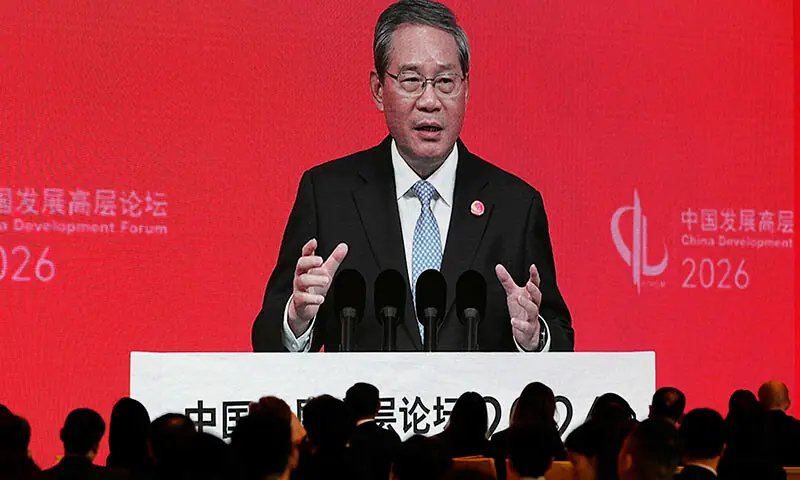
Chinese Premier Li Qiang signaled a renewed commitment to opening the nation’s economy and fostering more equitable trade relationships with global partners. Speaking at the China Development Forum in Beijing on Sunday, Li emphasized the country’s intention to import more high-quality foreign goods. This comes after a year marked by significant trade tensions, particularly with the United States and the European Union.
The forum, which wraps up Monday, serves as a crucial platform for Beijing to articulate its economic strategies and highlight investment prospects to an international audience. The premier’s remarks follow the announcement of China’s record $1.2 trillion trade surplus for the past year. These pledges suggest an acknowledgment of international concerns regarding trade practices and potential overreliance on certain Chinese exports.
While the trade surplus wasn’t directly addressed by Li, his commitment to balanced trade indicates a strategic effort to ease ongoing friction. This development is particularly timely, given a recent temporary trade truce with the U.S. and the postponement of a high-level meeting between the two economic giants. The global economic landscape remains sensitive to these large trade imbalances.
Supporting these sentiments, the governor of China’s central bank, Pan Gongsheng, also spoke at the forum, aiming to alleviate concerns about the trade surplus. Pan highlighted the importance of considering trade in services and financial accounts alongside goods trade when assessing global economic imbalances. He asserted that China has no intention of gaining a competitive edge through currency devaluation.
This push for openness coincides with efforts to revitalize foreign investment, which experienced a downturn in early 2025. China has been actively expanding incentive programs for foreign investors, particularly in advanced manufacturing and modern services. These measures aim to reverse the recent decline and attract further international capital into key sectors of the economy.
Comments (0)
No comments yet. Be the first to comment!
Leave a Comment