

Ceasefire Strains and Global Responses in the Israel-Hamas Conflict
The fragile ceasefire between Israel and Hamas continues to face challenges as reports of airstrikes, land disputes, and political tensions dominate the landscape. Despite international efforts to stabilize Gaza, violations and escalations persist.
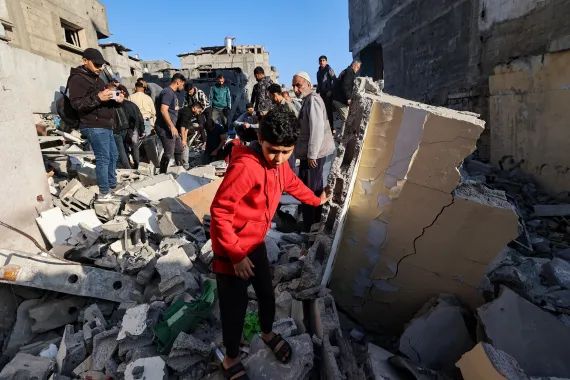
Recent Israeli airstrikes across Gaza killed dozens of Palestinians, including families in tent encampments. Officials claim the strikes were in response to Hamas ceasefire violations, while Palestinian groups denounced them as massacres targeting displaced civilians. The attacks highlight the volatility of the truce and the humanitarian toll on Gaza’s population.
In the West Bank, Israel approved a controversial plan to register occupied land as “state property.” Palestinian leaders condemned the move as a serious escalation, arguing it undermines signed agreements and violates international law. Hamas described the decision as an attempt to forcibly impose settlement and “Judaise” Palestinian lands.
Global actors are stepping in with pledges of support. The Board of Peace, led by U.S. President Donald Trump, announced commitments exceeding $5 billion for Gaza’s reconstruction and humanitarian relief. Plans also include deploying a UN‑authorized stabilisation force to restore order and assist local governance.
Palestinian President Mahmoud Abbas warned that Israel’s actions threaten the second phase of the ceasefire agreement. He stressed the need to remove obstacles to ensure continuity of services, humanitarian coordination, and recovery efforts. Abbas noted that over 500 Palestinians have been killed since the ceasefire began, raising doubts about its durability.
Meanwhile, humanitarian organizations face their own challenges. Médecins Sans Frontières suspended some operations at Gaza’s Nasser Hospital due to reports of armed men inside and concerns over weapons transfers. The suspension underscores the difficulty of maintaining neutrality and safety in conflict zones.
As the Board of Peace prepares for its upcoming meeting, the future of Gaza remains uncertain. International pledges offer hope for reconstruction, but ongoing violence and political disputes threaten to derail progress. The conflict’s trajectory will depend on whether ceasefire commitments are honored and whether global efforts can translate into lasting stability.
Comments (0)
No comments yet. Be the first to comment!
Leave a Comment