

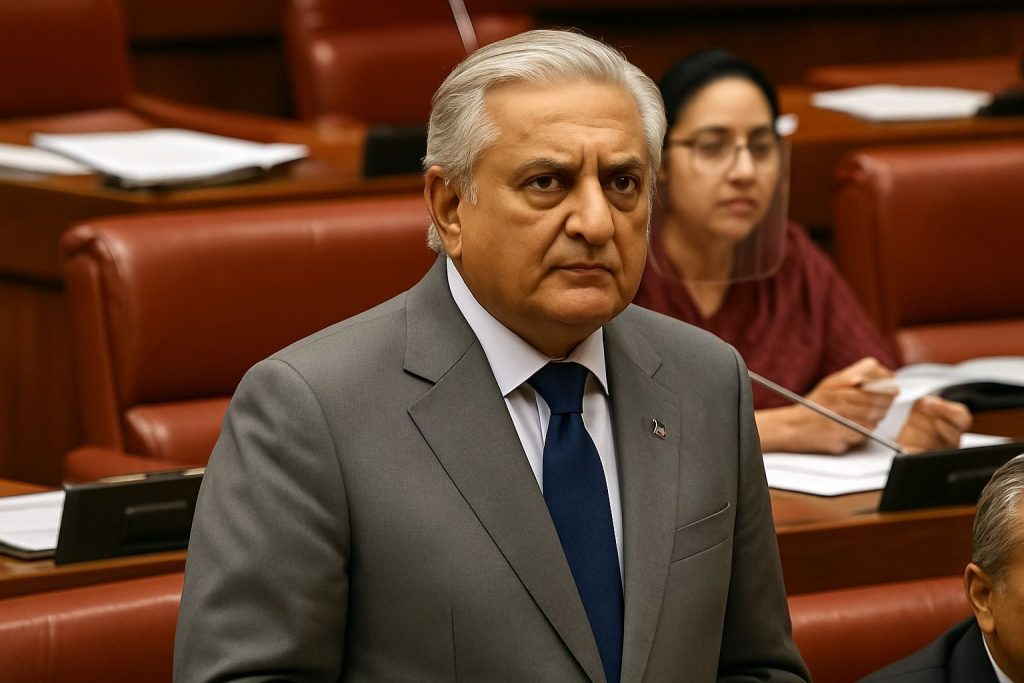
Deputy Prime Minister and Foreign Minister Ishaq Dar informed parliamentarians that Iran has reportedly agreed not to pursue nuclear weapons, a development that comes as the United States seeks the complete dismantling of Tehran’s nuclear program. Dar revealed this during a briefing to the Senate regarding Pakistan’s diplomatic efforts following recent attacks in the region. “I held a meeting with US Secretary of State Marco Rubio and disclosed that Iran had agreed not to build nuclear weapons, but the US wanted Iran’s entire nuclear programme to be completely dismantled,” he stated.
The ongoing Middle East conflict has seen significant escalation, with Israel attacking Iran and Tehran responding with missile and drone strikes targeting “US interests and bases” across Gulf states. The situation was further complicated by reports of casualties among senior Iranian leaders, including Supreme Leader Ayatollah Ali Khamenei, in airstrikes attributed to Israel and the United States. Iranian officials have vowed retaliation, calling the strikes a “great crime.”
During his address, Dar emphasized that Pakistan has worked to ensure Iran’s right to a peaceful nuclear program is recognized. He offered Islamabad as a venue for mediation between the US and Iran, highlighting the active and positive roles played by Prime Minister Shehbaz Sharif and Field Marshal Asim Munir in diplomatic and defense engagements.
Dar detailed his immediate contact with the Iranian foreign minister to condemn the strikes and conveyed condolences from Pakistan’s government and people on the martyrdom of Ayatollah Khamenei. He also spoke with foreign ministers from numerous countries, including Turkey, Saudi Arabia, and the UAE, to discuss the escalating crisis.
Information from the Omani foreign minister suggested positive progress in Iran-US talks prior to the attacks, a point Dar found concerning. He reiterated Pakistan’s commitment to resolving the matter through extensive diplomatic and back-channel efforts, noting that Iran’s leadership is fully aware of Islamabad’s initiatives.
Pakistan’s support for Iran’s peaceful nuclear energy utilization was also highlighted, recalling Pakistan’s past efforts at the UN Security Council. Dar drew parallels between the recent attacks and an incident in June of the previous year, where Field Marshal Munir was involved in discussions urging Iran towards diplomatic resolution.
Dar addressed public concerns, stating Pakistan stands with Iran and clarifying that while some advocated for continued monitoring of Iran’s program, Pakistan’s role was in facilitating dialogue. He commended Field Marshal Munir’s efforts in de-escalating tensions through defense channels. Dar stressed the importance of Pakistan not being drawn into the conflict, despite carrying out swift condemnation of the attacks.
He affirmed that Pakistan’s diplomatic endeavors are ongoing, with a decision made to continue efforts aimed at reducing regional tensions. Leaders of contacted nations expressed that patience could have facilitated regional dialogue. Pakistan has a strategic agreement with Saudi Arabia and remains in contact with Iran. Dar confirmed that Pakistan conveyed assurances to Iran, sought by Tehran regarding its territory, and that Saudi Arabia provided similar assurances. Pakistan played a role in facilitating these assurances.
In terms of the Pakistani diaspora, Dar reported that approximately 35,000 Pakistanis are in Iran, with the Taftan-Zahedan border operational. Over 790 Pakistanis have been evacuated, and while roads remain open, airspace closures have necessitated alternative return routes.
Dar assured that parliamentary leaders would receive a more detailed briefing. He described the regional situation as highly challenging and conflict-ridden, reiterating the government’s full diplomatic engagement.
Comments (0)
No comments yet. Be the first to comment!
Leave a Comment